


Bitcoin’s network hash rate is falling right now, just like it does every year. Here’s the seasonal mechanic behind it, and why curtailment is a feature of North American mining, not a bug.
1. Bitcoin mining is a North American industry, and it breathes with the seasons.
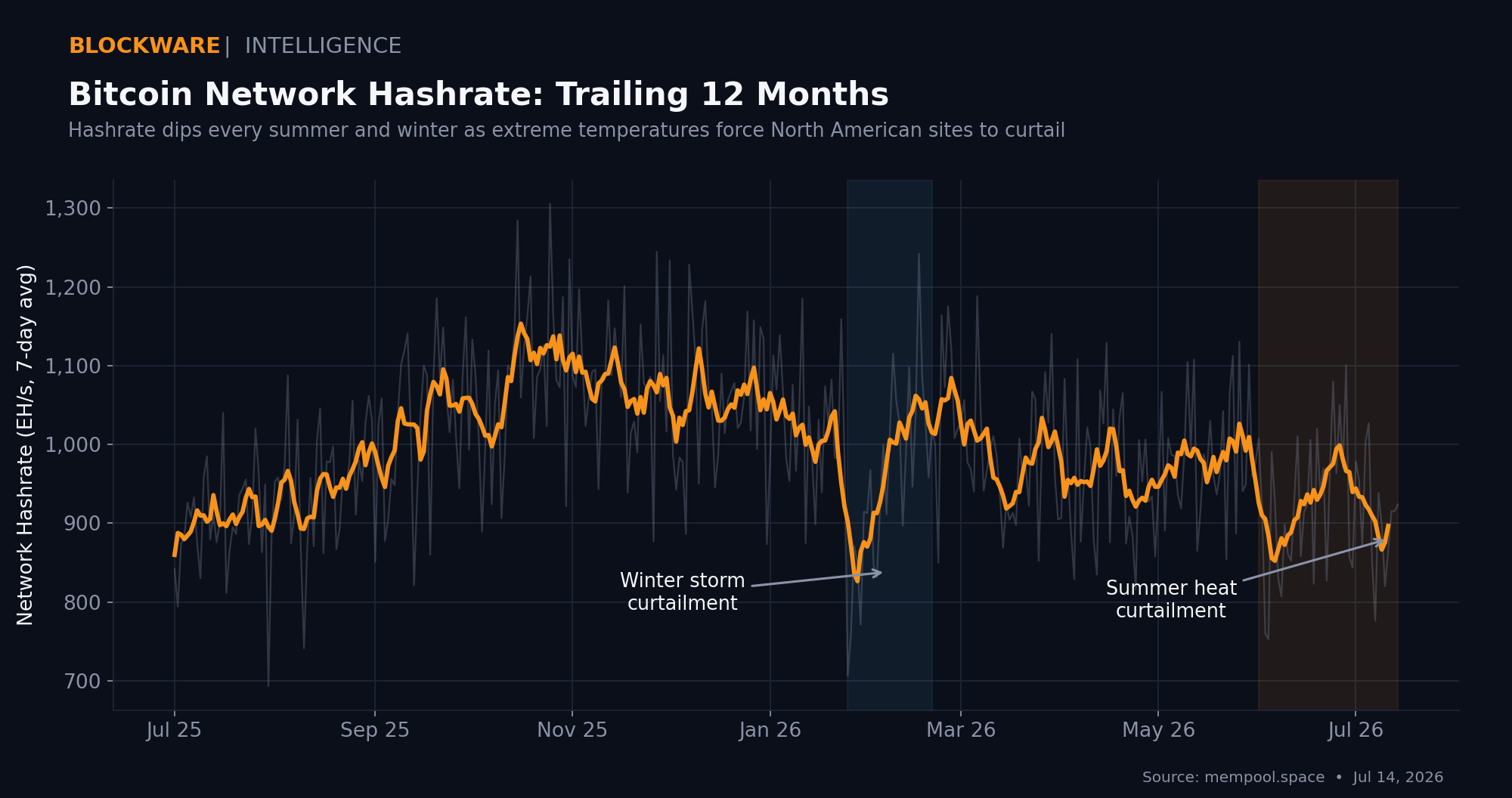
The majority of global hash rate now sits in Texas and elsewhere in North America, where miners run on interruptible power agreements. When summer heat drives grid demand up, mining sites curtail and send power back to the grid, the same mechanism that gives miners access to cheap power in the first place. The pattern is visible in the data: hash rate dipped during February’s winter storms and is dipping again amid the current Texas heat.
2. When sites curtail, difficulty falls.
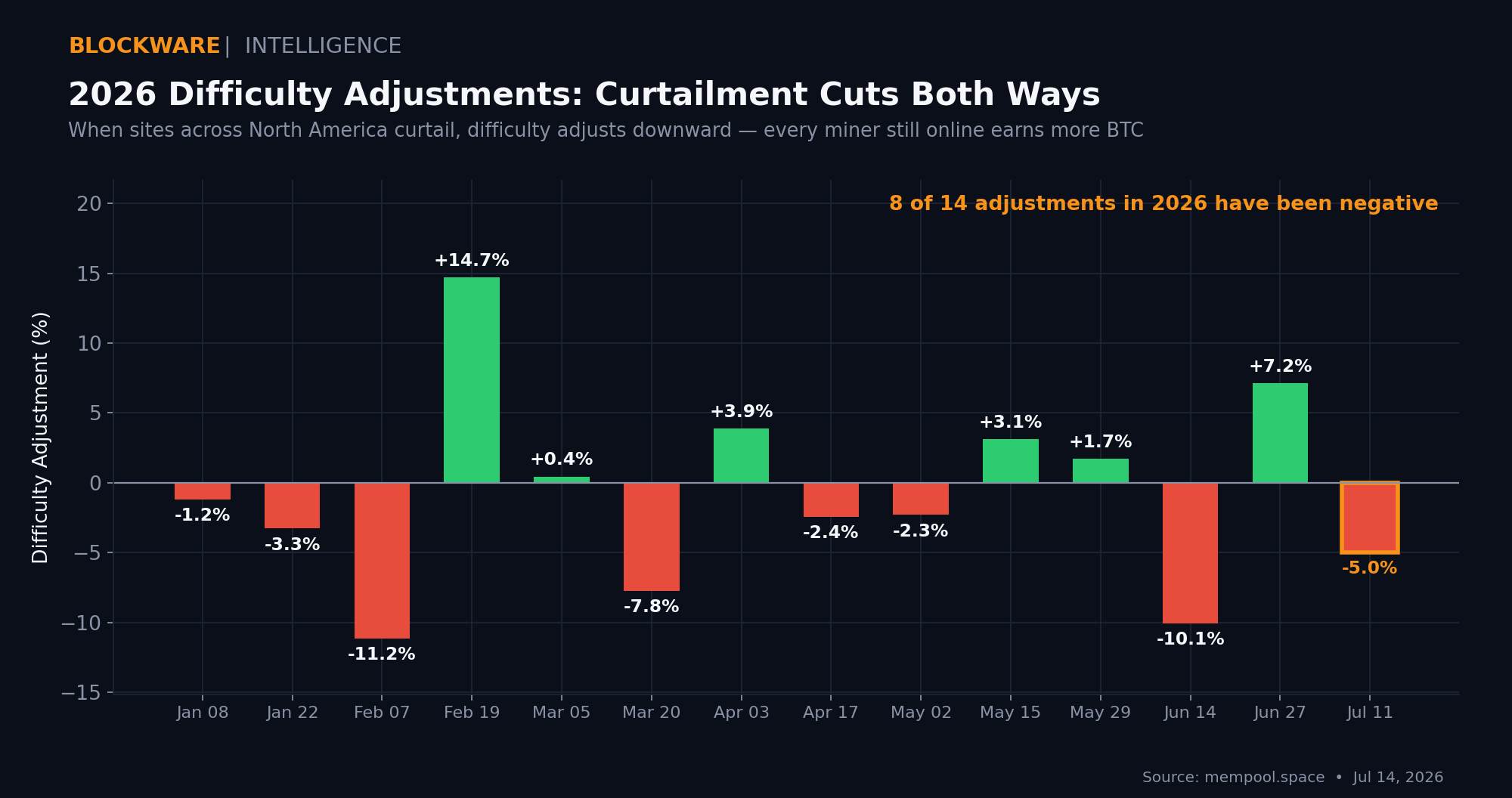
Bitcoin recalibrates mining difficulty every 2,016 blocks (~2 weeks) based on realized network hash rate. Because curtailment hits large swaths of the network simultaneously, 8 of the 14 difficulty adjustments in 2026 have been negative, including -11.2% during February’s freeze, -10.1% in mid-June, and -5.0% on July 11.
3. Lower difficulty means more BTC per unit of hash rate.
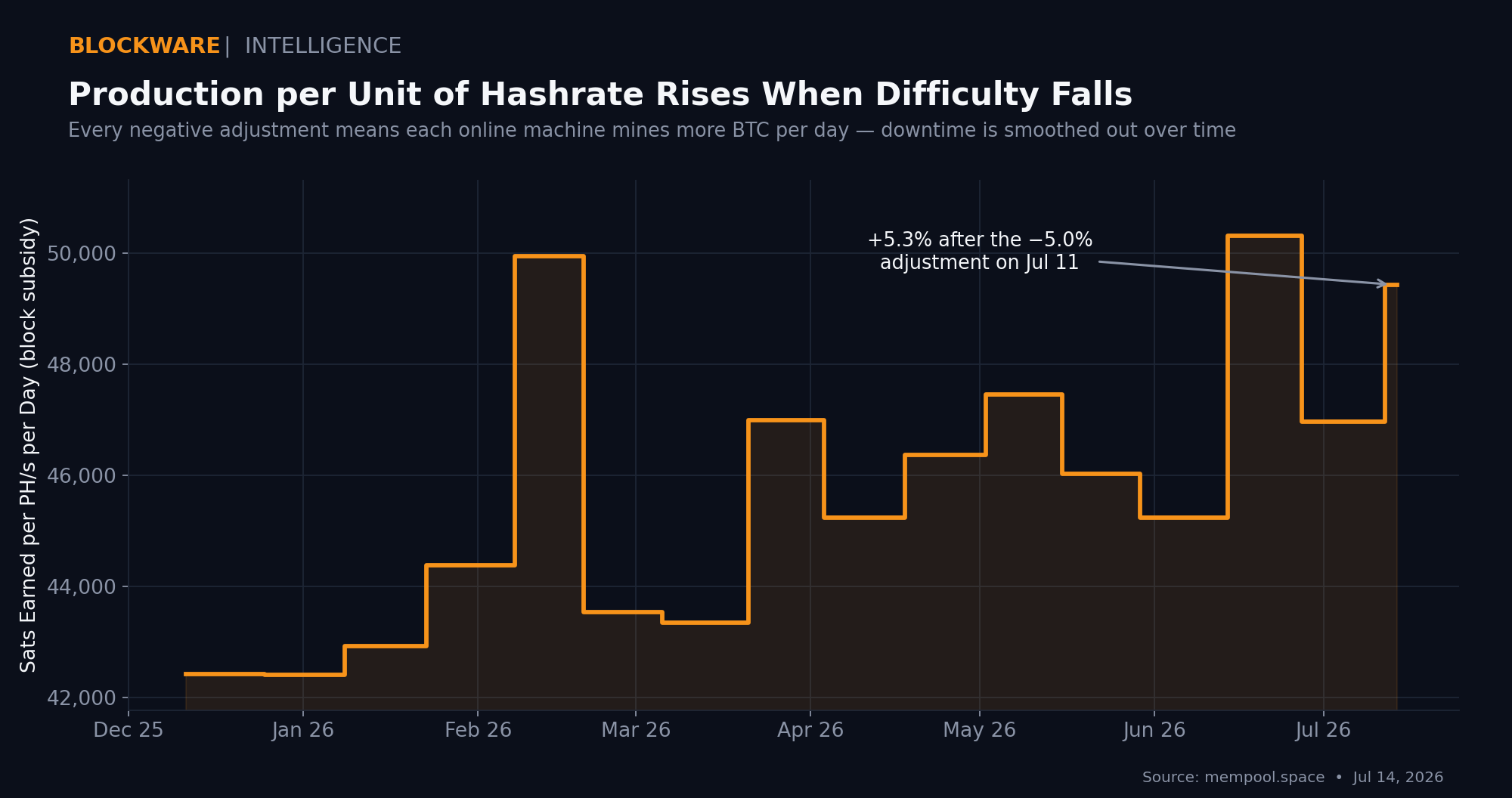
Every negative adjustment increases the BTC earned per PH/s per day. After the July 11 adjustment, machines that are online earn ~5% more BTC per day than they did two weeks prior. This is the network’s smoothing mechanism: production paused during curtailment is partially recouped when machines come back online at lower difficulty. For miners, short-term downtime largely washes out over a full season.
4. Zoom out
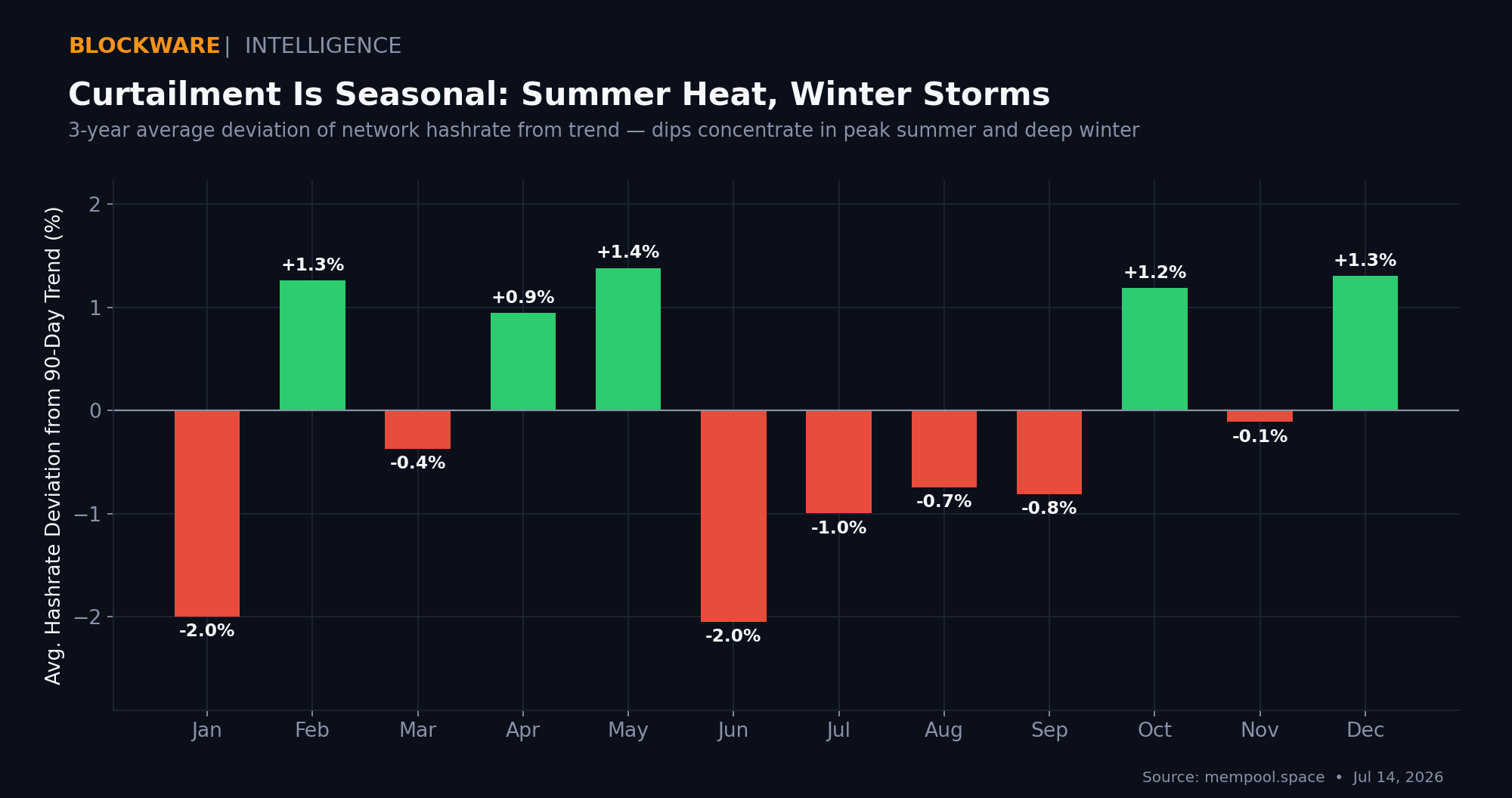
Three years of network data show hash rate reliably running below trend in peak summer (June – September) and deep winter (January), then rebounding in the shoulder months. Curtailment season is as predictable as the Texas heat that drives it.
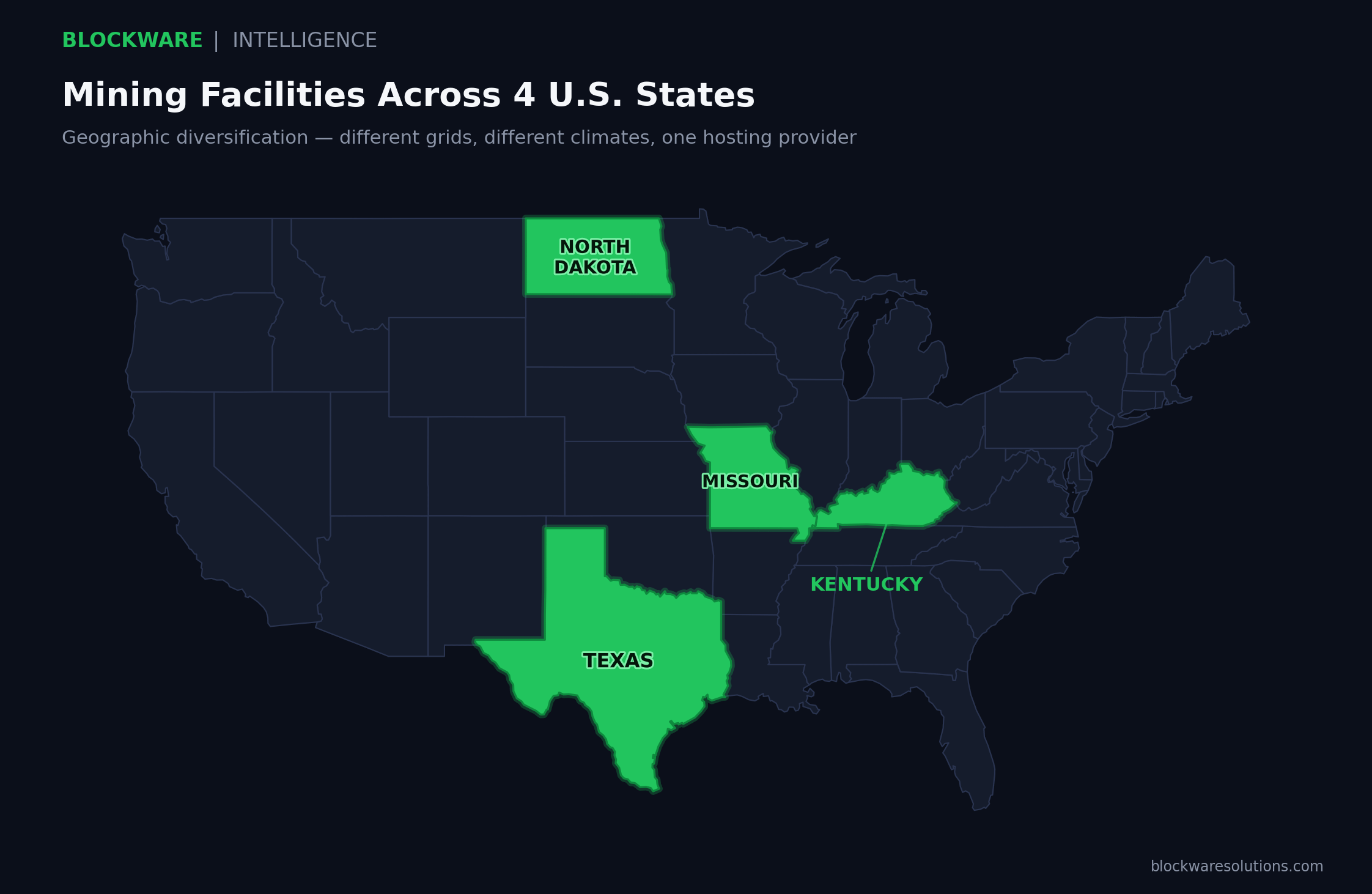
The takeaway for miners: diversification is the hedge. Fleets concentrated in one grid region carry that region’s full curtailment exposure, and air-cooled machines bear the brunt of extreme heat. Spreading across hosting locations, and building a mixture of air-cooled, hydro, and immersion machines, smooths both site-level and machine-level downtime.
Blockware has mining facilities in 4 different US States, enabling geographic diversification with the simplicity of one hosting provider.
Contact sales@blockwaresolutions.com to learn more. Or, sign up for the Blockware Marketplace to start mining today.
The on-chain signals are firing in textbook formation. The structural question this cycle is whether they're still sovereign. At 0.96 Nasdaq correlation, the marginal Bitcoin buyer is a rebalancing rule inside an equity portfolio. An on-chain bottom can be overridden by an equity market event the blockchain can't see.