Four Tax Problems Bitcoin Mining Solves
Most people understand the mechanics of the strategy by now: ASIC miners are qualifying business equipment under Section 168(k), which means 100% of the hardware cost is deducted in year one, and the machines produce Bitcoin every day after that.
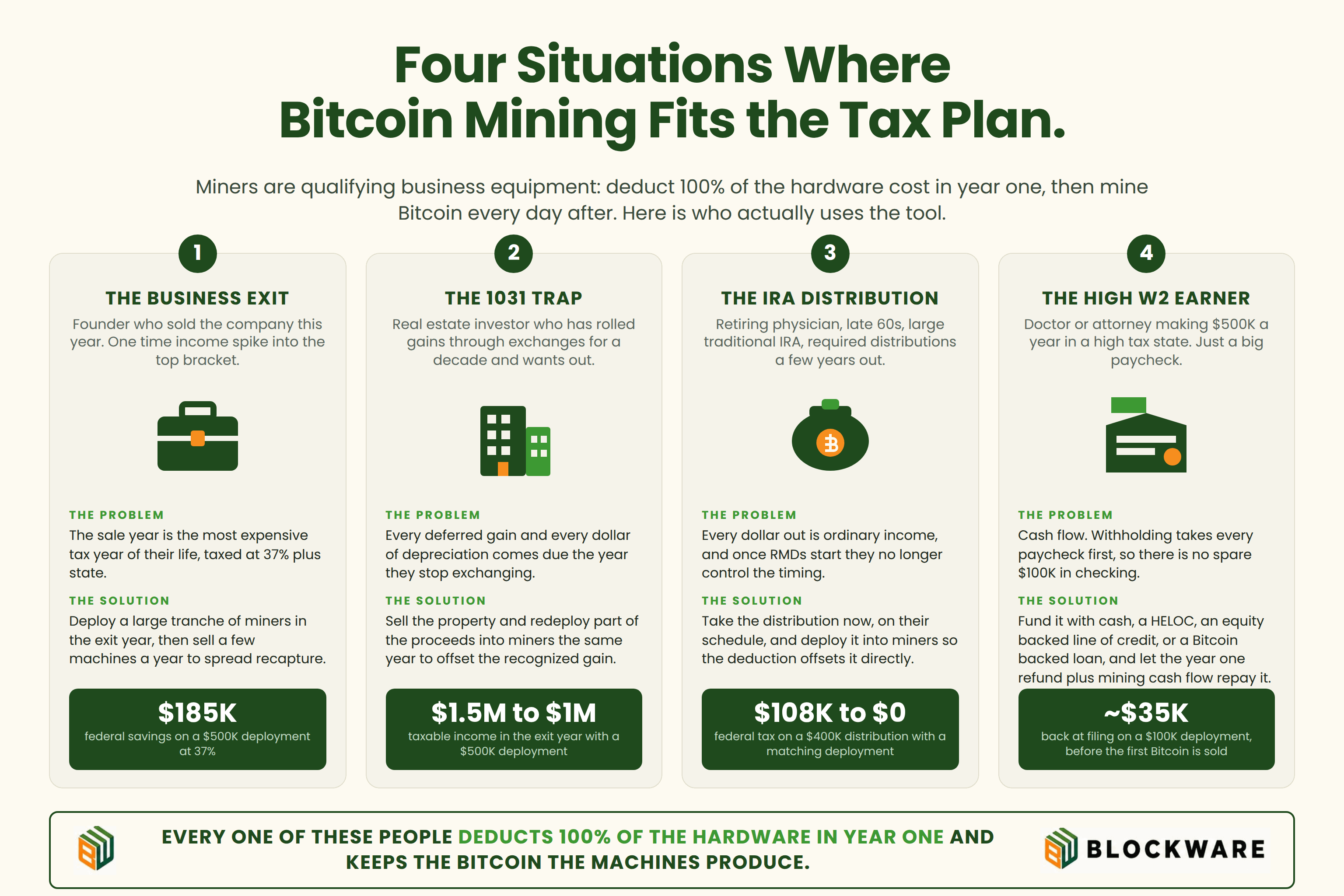
The question we get more often is “does this actually apply to me?” To answer that, we put together four case studies from the types of clients we with:
CASE STUDY 1: THE BUSINESS EXIT
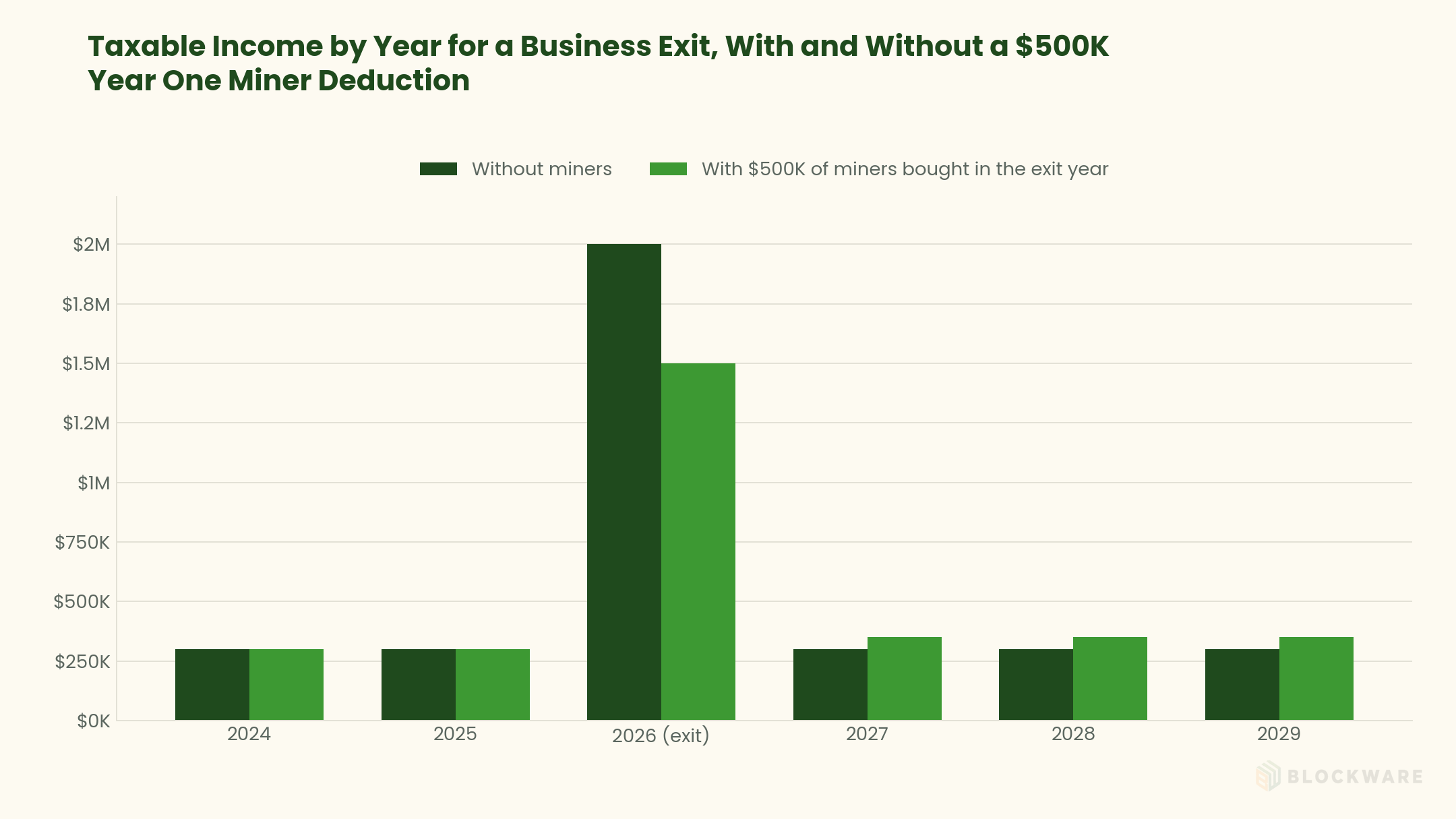
You sold a company this year, or you’re about to. The sale creates a one time spike in income that pushes you into the top bracket for a single year, and the IRS treats that year like every other one. Buying miners in the year of the exit deducts the full hardware cost against that income, at the highest marginal rate you’ll ever pay. A $500,000 deployment in the 37% bracket is a $185,000 reduction in federal taxes, and it converts a chunk of the sale proceeds into hardware that mines Bitcoin for years. Because the deduction lands in year one and the machines can be sold off gradually, you can spread any recapture across future years when your income is back to normal.
CASE STUDY 2: THE 1031 TRAP
You’ve rolled real estate gains through 1031 exchanges for a decade and now you want out. The problem is that every deferred gain and every dollar of depreciation you’ve taken comes due the year you stop exchanging. Most investors feel stuck: keep buying properties you don’t want, or take the tax hit. Miners are a third option. They’re depreciable equipment in a new active business, so the year you exit real estate, the miner deduction offsets a large portion of the recognized gain. You move capital from a building into Bitcoin mining hardware, and the tax bill that was keeping you in real estate gets much smaller.

CASE STUDY 3: THE IRA DISTRIBUTION
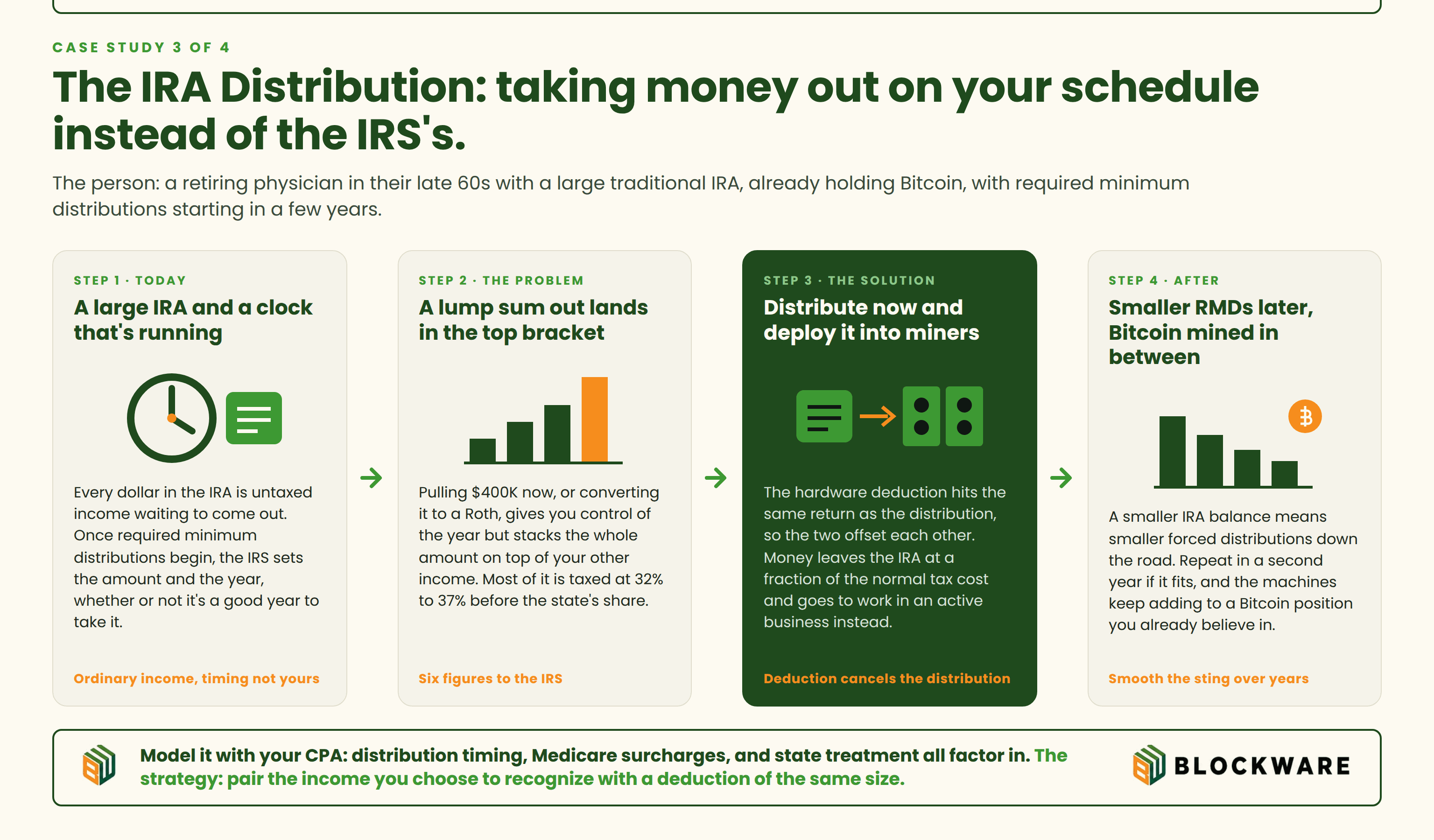
You’re in your late 60s or early 70s with a large traditional IRA, and required minimum distributions are a few years out. Every dollar that comes out is ordinary income, and once RMDs start, you no longer control the timing. Pulling a lump sum now, or converting to a Roth, lets you choose the year, but it also means a $400,000 distribution taxed at the top bracket. Deploying that capital into miners deducts the hardware cost directly against the distribution, so the effective tax rate on getting money out of the IRA drops dramatically. Most of the people in this situation already hold Bitcoin and are comfortable with the asset, so mining is a natural extension of what they’re already doing.
CASE STUDY 4: THE HIGH W2 EARNER
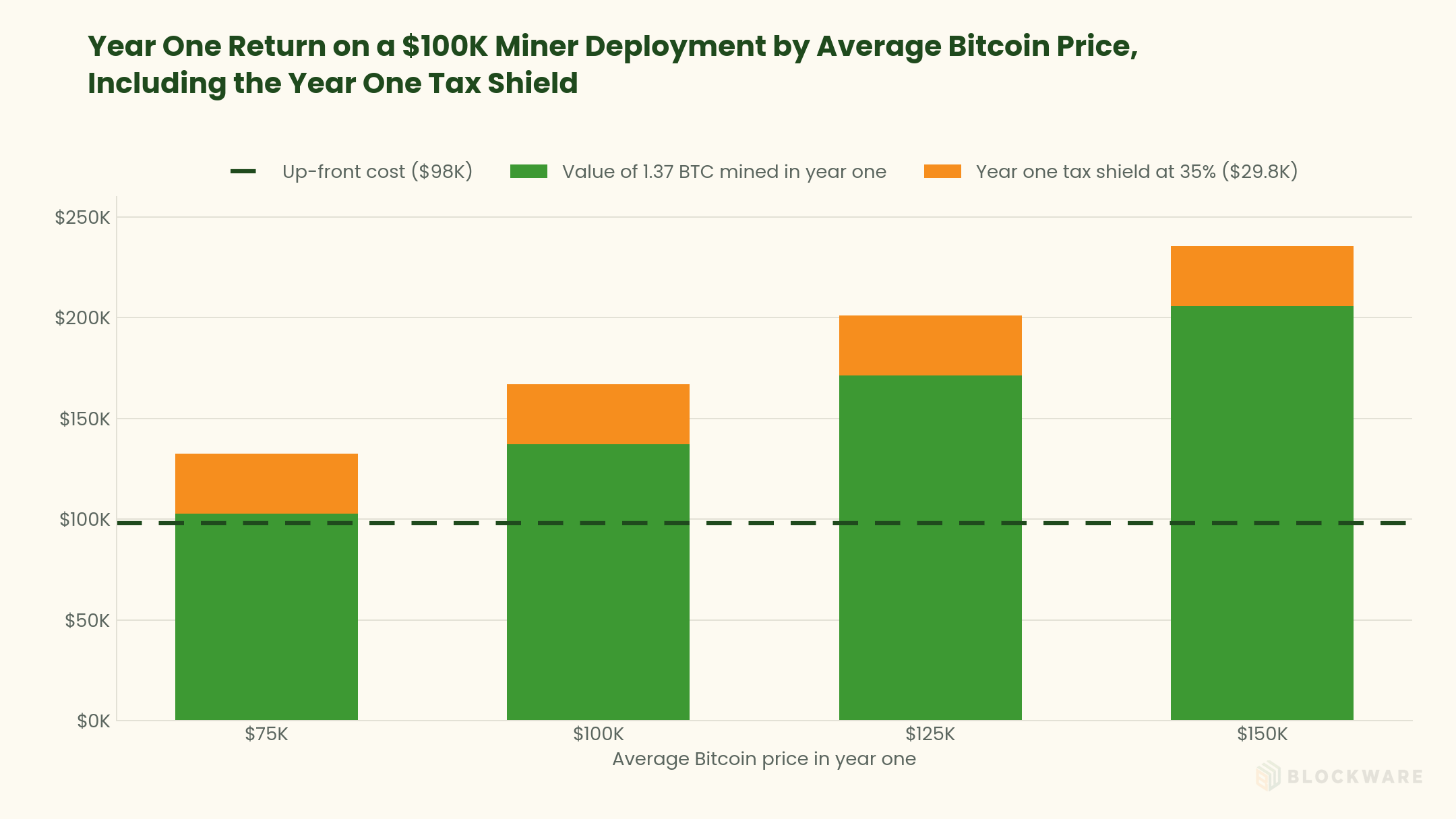
You’re a physician, attorney, or executive making $500,000 a year, and the last $200,000 of that is taxed at 35% or higher before your state takes its cut. The strategy works, but the obstacle is cash flow. Withholding takes its share of every paycheck, so there’s rarely a spare $100,000 sitting in checking. The clients who make this work usually fund the deployment with a home equity line of credit. The year one deduction on $100,000 of miners returns roughly $35,000 at filing, which goes straight toward paying down the line, and the machines mine Bitcoin every month in the meantime. One note for readers in California and New York: your state doesn’t fully conform to federal bonus depreciation, but the federal deduction is still the larger benefit by a wide margin.
WHAT ALL FOUR HAVE IN COMMON
Each of these people needs to be an active participant in the mining business to deduct against ordinary income, which in practice means documenting 100 hours of qualifying activity across the year. Modeling the deployment, setting up wallets and accounts, monitoring the dashboard, and visiting a facility all count. Starting in October leaves plenty of runway to get there. The other thing they share is a deadline: equipment has to be placed in service before December 31 to count for 2026, and every week that passes narrows the window to model the strategy properly with your CPA and advisor.
Tomorrow (Tuesday, September 29 at 11 AM ET) we’re hosting a live Bitcoin Masterclass with Phil Geiger and Jessy Gilger of Verify Wealth, a financial planning firm built for Bitcoiners. We’ll spend the first half hour on how mining works as a tax tool and the second half on live Q&A.
Sign up here: https://blockwaresolutions.com/webinar