


If you make over $150k per year, you could be 5 to 7 years away from retiring. Our partner Mark Moss will show you how in this free guide:

Franklin Templeton announced a new line of ETFs which blend the S&P and NASDAQ with Bitcoin.
FEBQ (95% S&P 500, 5% BTC, DRIP Invested into Bitcoin)
FIBT (95% NASDAQ 100, 5% BTC, DRIP Invested into Bitcoin)
These ETFs will utilize a “DRIP” strategy, in which dividends are reinvested rather than distributed. However, the key difference from a traditional “DRIP” is that the dividends will be reinvested into Bitcoin rather than the underlying basket of equities.
There is an insatiable appetite for lower-volatility Bitcoin exposure; Strategy’s preferred equity products have made this clear. Products like this are targeting that same market.
Investors want to have their cake and eat it too (high returns, minimal drawdowns). These products show potential to deliver that. There are a few drawbacks to the proposed structure, but first let’s take a look at how these products would have performed in the past few years had they existed.
The table below compares each fund to the underlying equity basket.
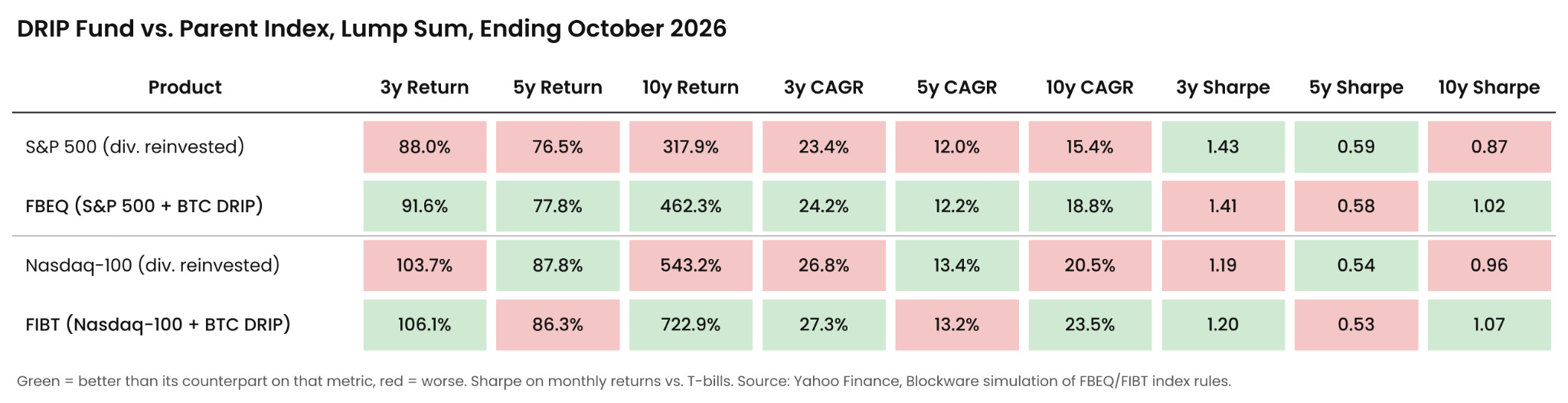
The “BTC Enhanced” S&P 500 has outperformed the S&P 500 itself on each time frame measured (3, 5, and 10 years) with a higher sharpe ratio on the 10-year measurement.
The “BTC Enhanced” NASDAQ has outperformed on a 3 and 10-year time horizon, with a higher sharpe on each of those.
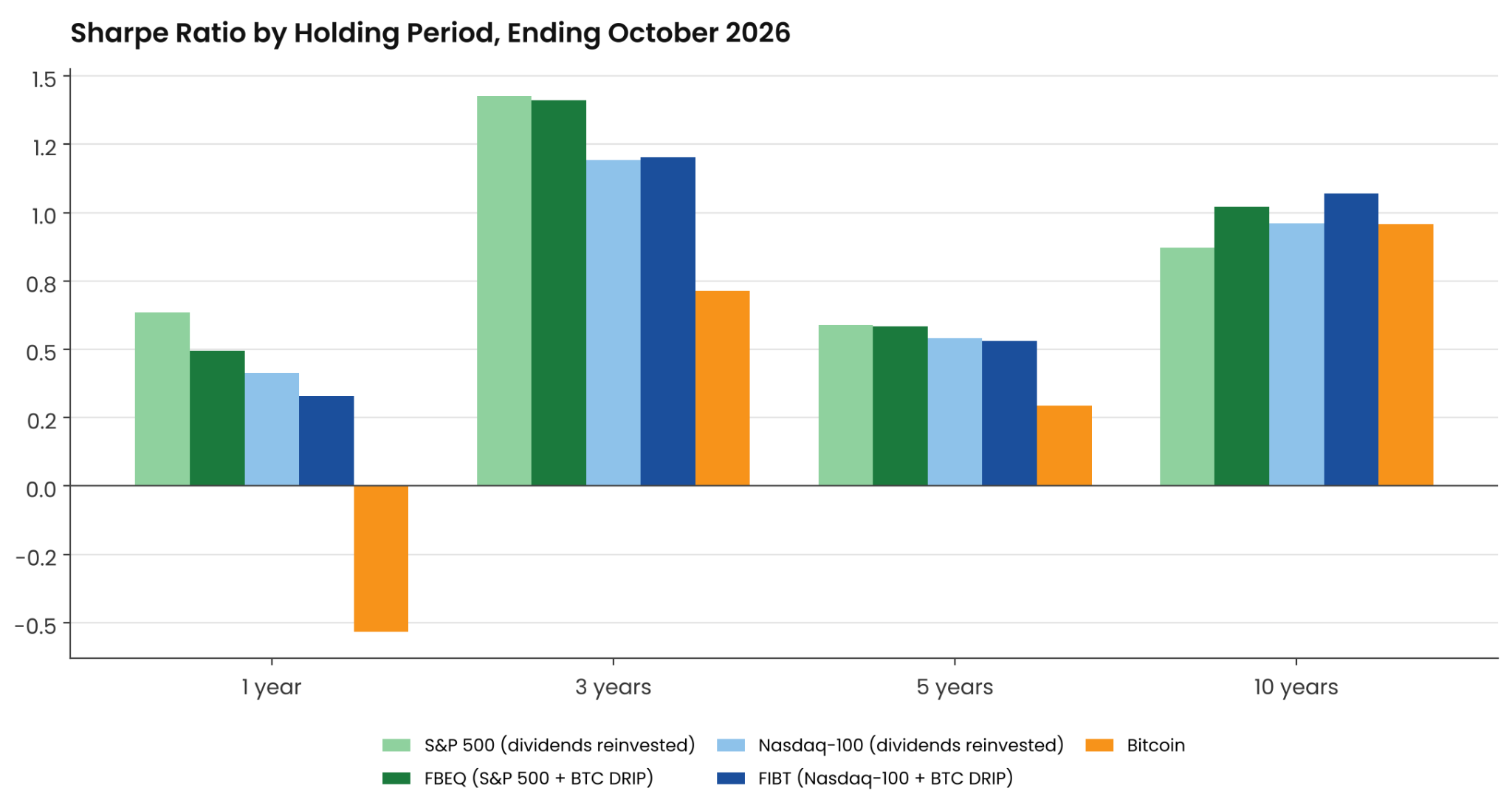
On a purely risk-adjusted basis (sharpe ratio), both FBEQ & FBIT would have outperformed Bitcoin itself over the past 3, 5, and 10 years.
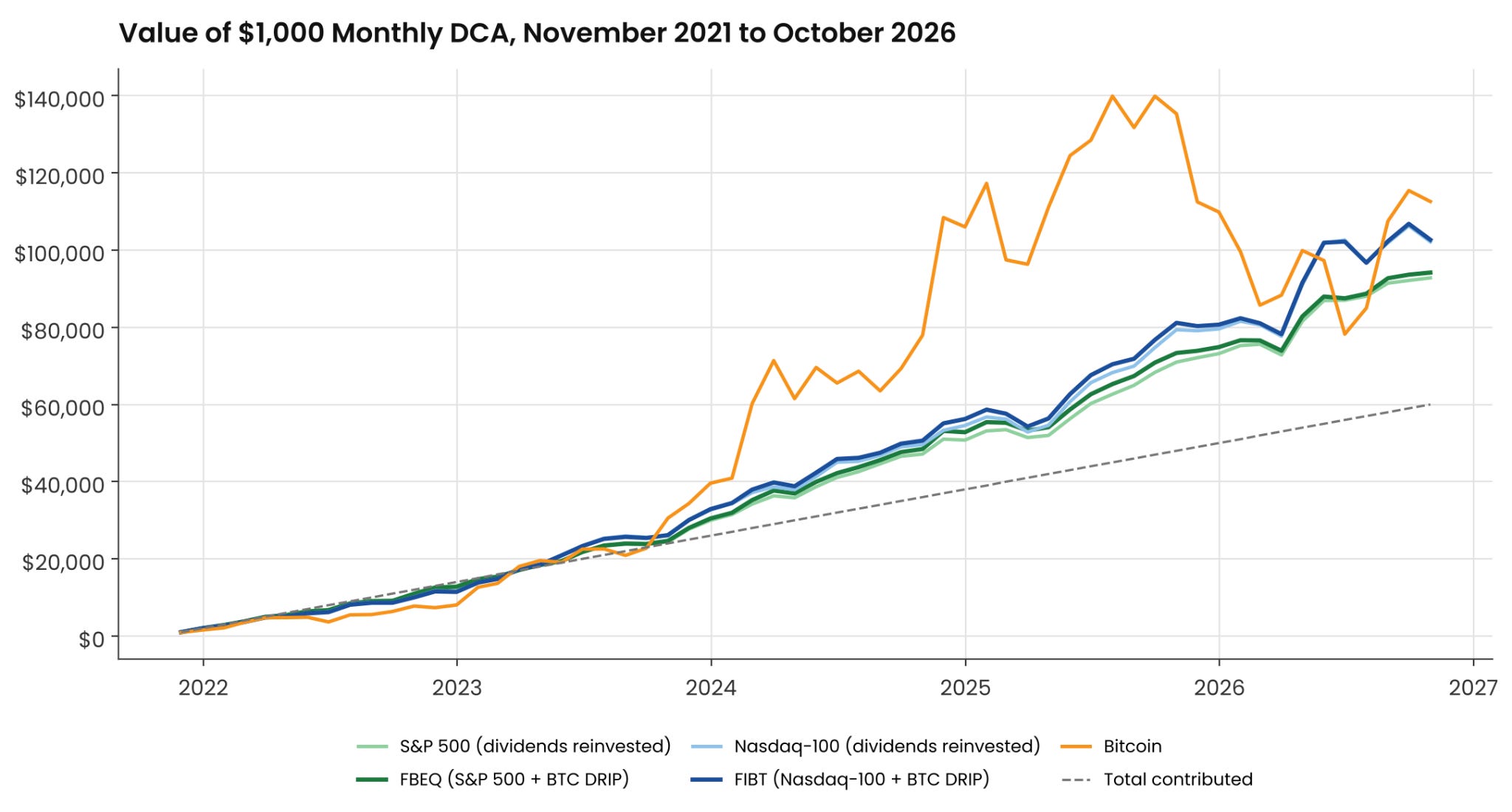
For investors less concerned with volatility, Bitcoin has still dominated from a total-return perspective. Measuring from the previous cycle’s bull market top (5 years ago / November 2021), a monthly DCA into Bitcoin has outperformed a monthly DCA into both FBEQ & FBIT.
Bitcoin’s volatility is what enables outsized returns.
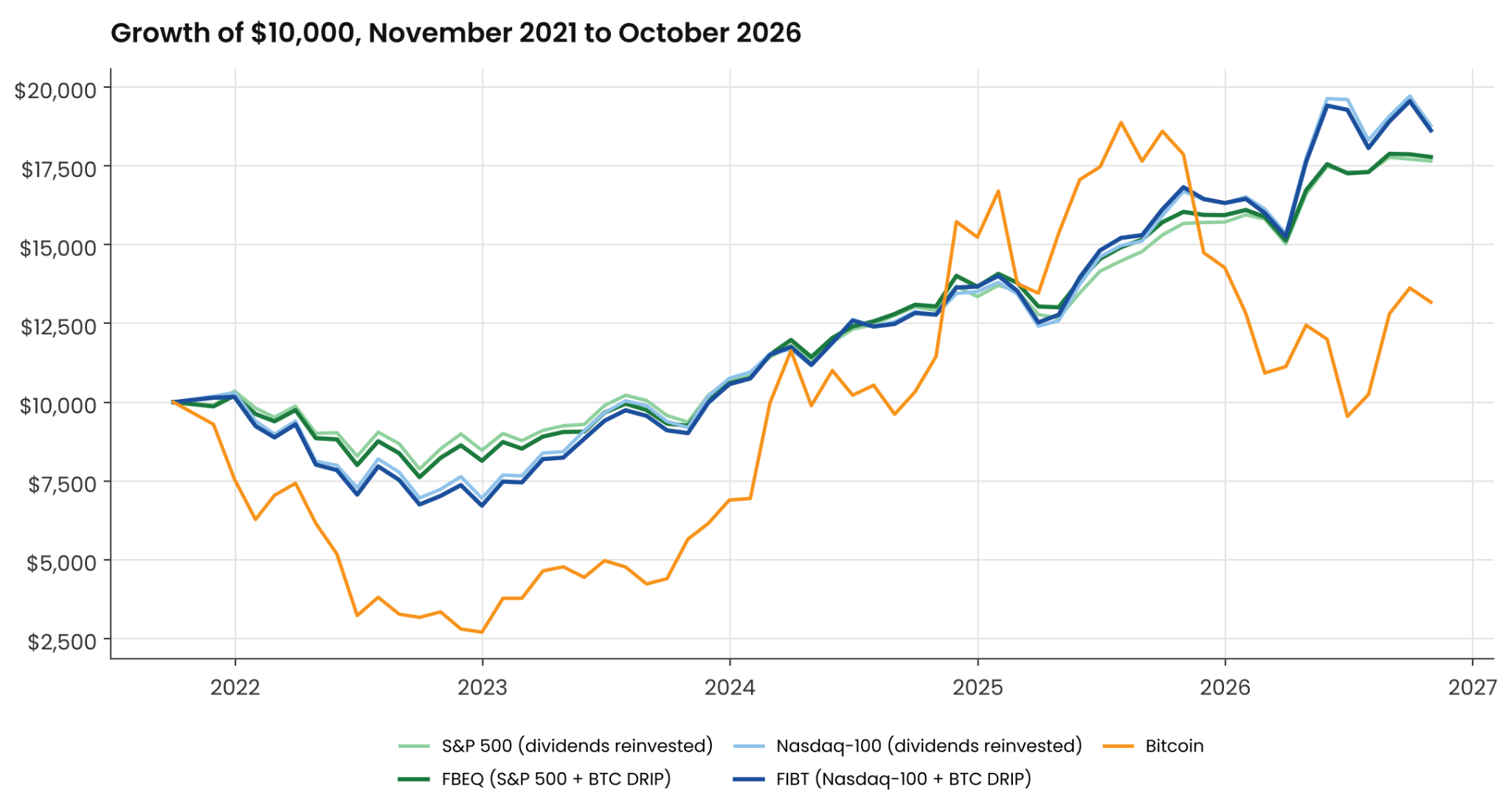
That being said, Bitcoin’s volatility necessitates a dollar-cost average approach. The chart below measures total returns across the same time frame, but with a “one time” purchase rather than with consistent capital allocation. Bitcoin has drastically underperformed the alternatives with this strategy.
One downside to this structure is that these funds only rebalance if the Bitcoin portion gets too high. If Bitcoin has a bad month or a couple of bad months and the Bitcoin position gets low, they do not organically buy Bitcoin. They just keep buying it with the dividends, which at a 1% yield on the S&P 500 is a very slow drip. So the right way to understand it is that they are selling Bitcoin when it rips, but not necessarily buying when Bitcoin is at a discount.
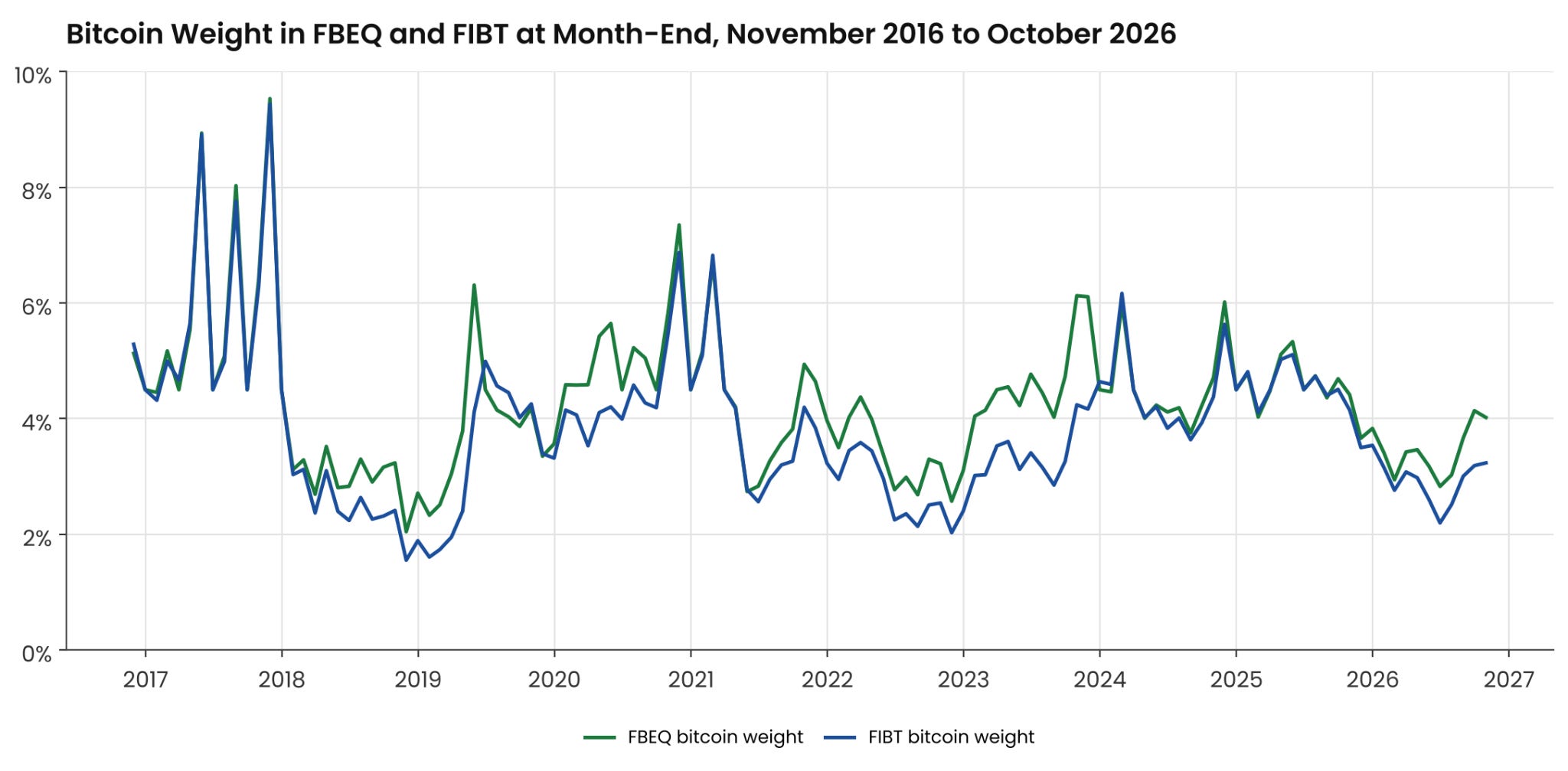
Zooming out, this is yet another domino in institutional adoption. Franklin Templeton already has a spot Bitcoin ETF, and with under half a billion in AUM it is not massive by any means, so these new products will probably land somewhere in that same ballpark. But the size is not really the point. Every new wrapper like this is another on-ramp for capital that was never going to buy Bitcoin directly, and a dividend stream that gets automatically converted into Bitcoin every quarter is a small but consistent source of buy pressure that did not exist before. More ways to get exposure means more capital coming into the market, and that is good for the price over the long term.
The most tax-efficient way to build a Bitcoin position is through mining. Every $ you spend on miners in 2026 can be depreciated against active or passive income. Blockware handles everything for your mining operation: deployment, pool configuration, power contracts, etc. We even have CPA partners that can help with your documentation come filing time.
Sign up for a free consultation to learn more: https://blockwaresolutions.com/info

Sign up for a FREE 3-part webinar series from The Bitcoin Way to learn why you need a Plan B residency and how to get one

The backtest point deserves more weight than the headline outperformance. A higher Sharpe ratio over 3, 5 and 10 years is not the same as maximising Bitcoin exposure, and the piece shows why: from the November 2021 cycle top, monthly dollar-cost averaging into Bitcoin still beat dollar-cost averaging into the enhanced funds on total return, while a one-time purchase lagged badly. That is a path-dependence warning. With a 95% equity and 5% Bitcoin starting mix, and a dividend drip of only about 1% on the S&P 500, the Bitcoin weight can drift down for a long stretch before new dividends rebuild it. So I would frame FEBQ and FIBT as volatility-managed equity products with a Bitcoin kicker, not as a substitute for a deliberate Bitcoin allocation, and judge them on drawdown and Sharpe rather than on whether they keep pace with Bitcoin in a strong run.
The structure only rebalances when the Bitcoin sleeve gets too large, so the funds sell BTC into strength but only add through the roughly 1% S&P dividend stream. That asymmetry is a real limit on how much downside protection the wrapper gives.