If you’ve been around the Bitcoin, finance, and/or technology space over the past year, you’ve likely heard about “Bitcoin Miners Pivoting to Ai.” Today we’re breaking down exactly why this is happening and what it means for the Bitcoin Mining industry.
The short answer for “why”: The industries are essentially fungible. Operating a Bitcoin mine and operating an Ai data center both require land and low-cost electricity. Some of the physical infrastructure is different but land and power are the key ingredients for both.
With Ai models in a neck-and-neck race, computing power has become a scarce resource. For an Ai company concerned with “speed to market” they’d much rather pay an existing data center (i.e. a Bitcoin Miner) for access to their facility rather than building their own from the ground up (which they are also doing). The trillion dollar Ai companies are essentially offering the billion dollar Bitcoin mining company a blank check for access to their data centers. Publicly traded Bitcoin Mining companies (or better said, “formerly bitcoin mining companies”) would be foolish to turn down these hosting agreements which offer higher margin, more consistent, long-term revenue.
Here’s how this “pivot” is impacting the Bitcoin Mining industry:
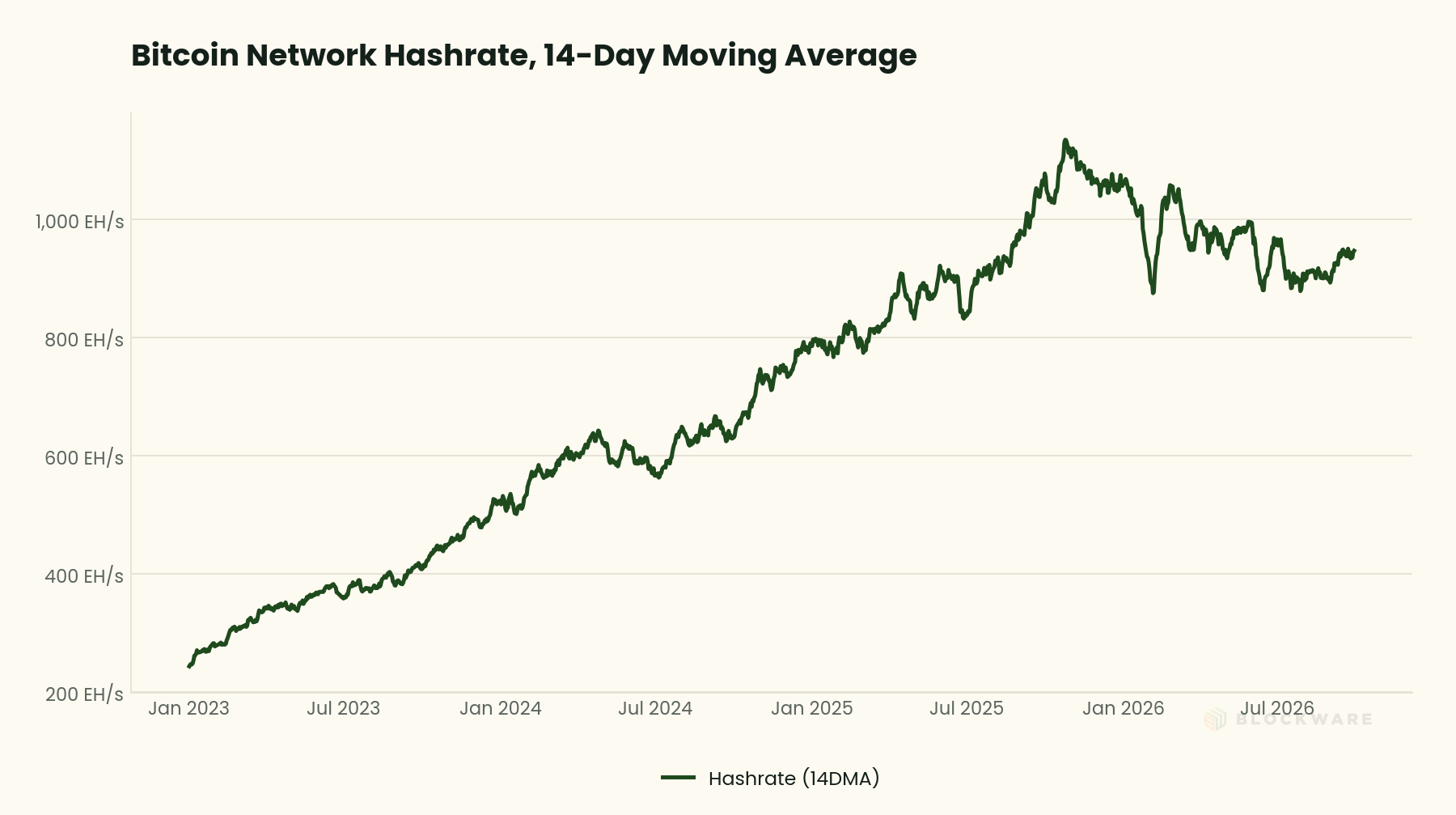
Network Hashrate is down year over year. The 14-day average sits at 946 EH/s, 17% below the October 2025 peak and down 10.5% from a year ago. The only other negative annual reading in Bitcoin’s history was the 2021 China ban.
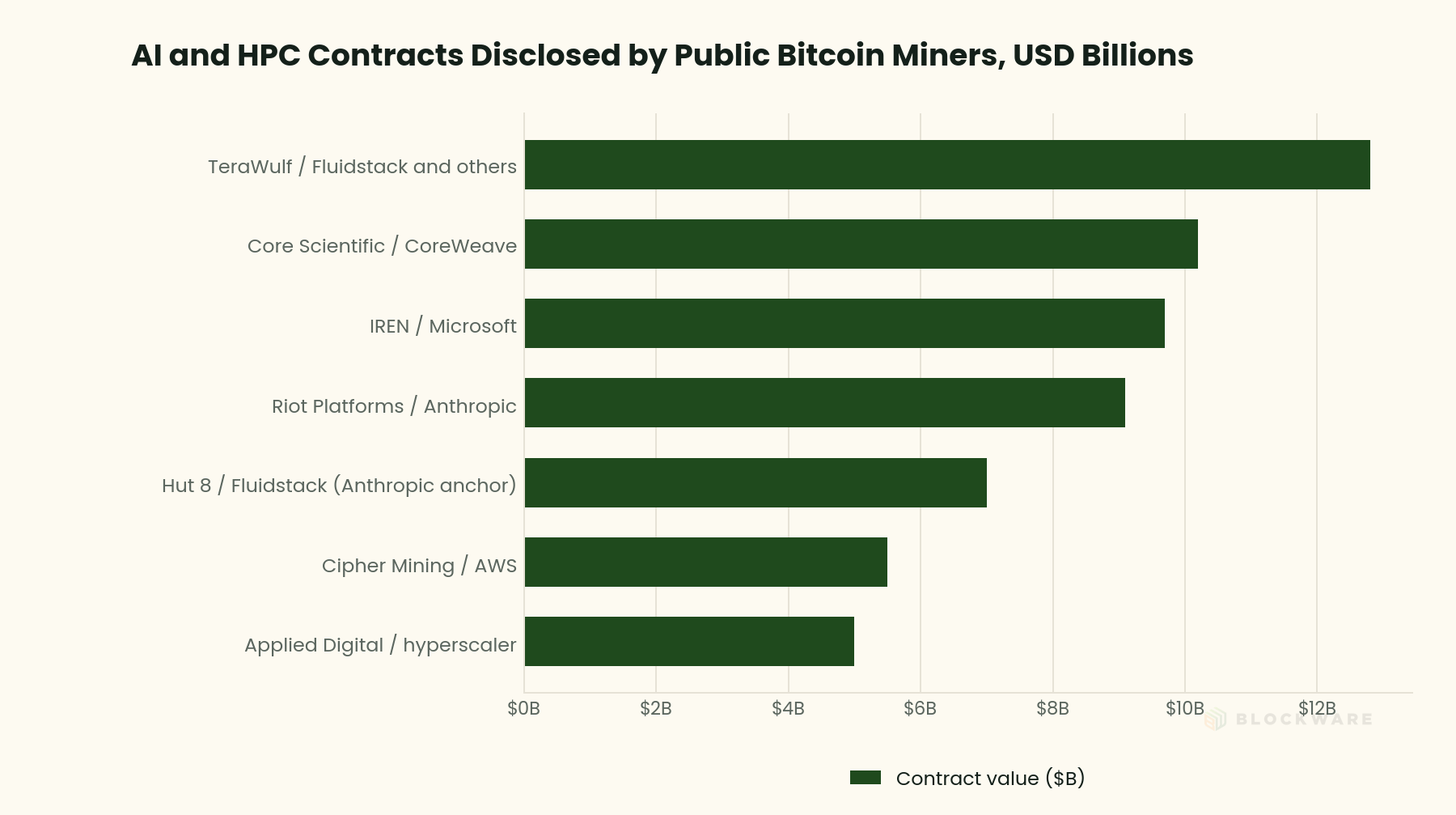
Public miners have signed over $70 billion of AI hosting contracts. Riot’s $9.1B, 20-year deal with Anthropic is the latest. The capacity behind those contracts is coming out of Bitcoin mining.
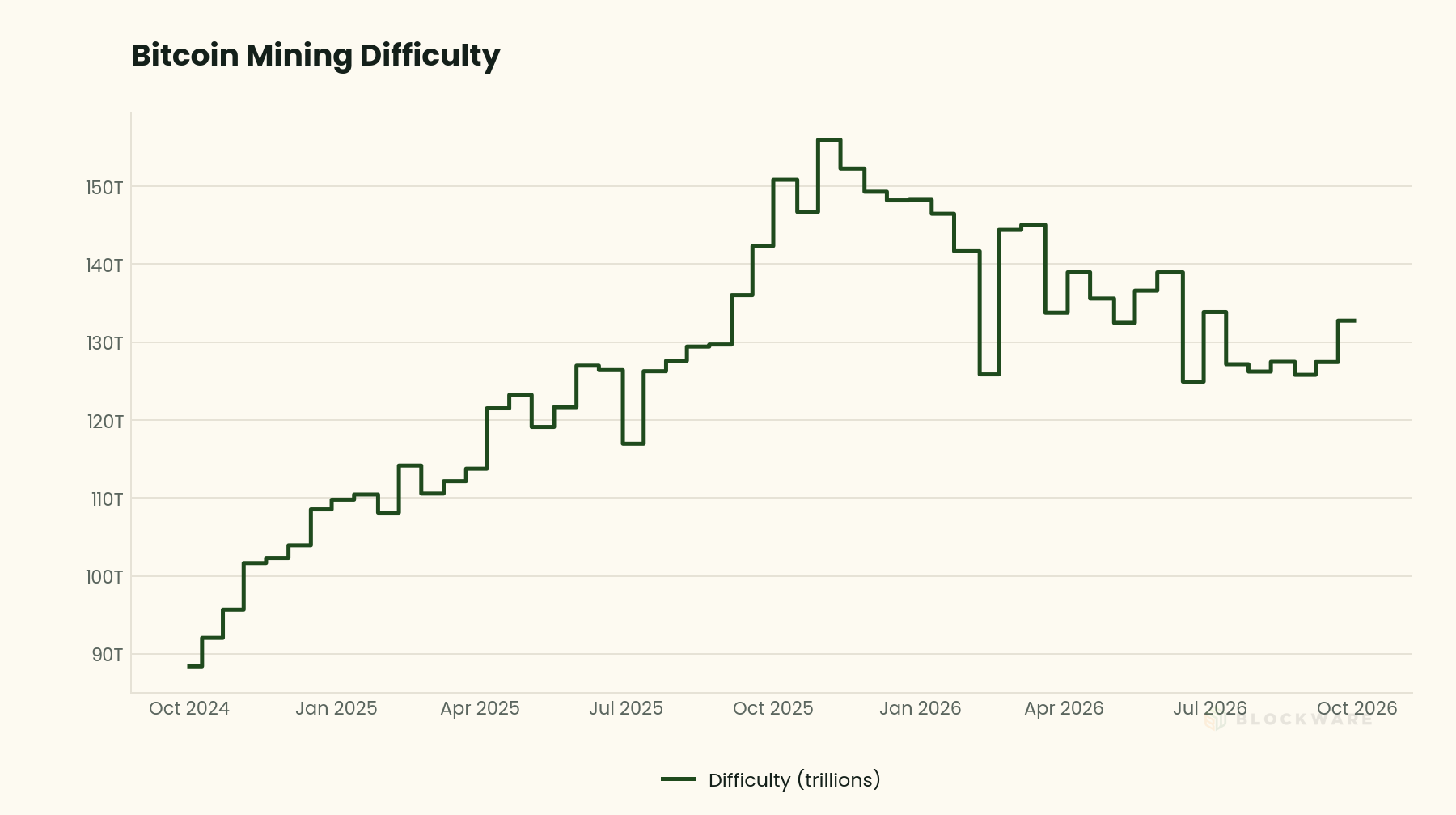
Difficulty is down 15% from its October 2025 high. 2026 has printed the two largest downward adjustments since 2021: -11.2% in February and -10.1% in June.
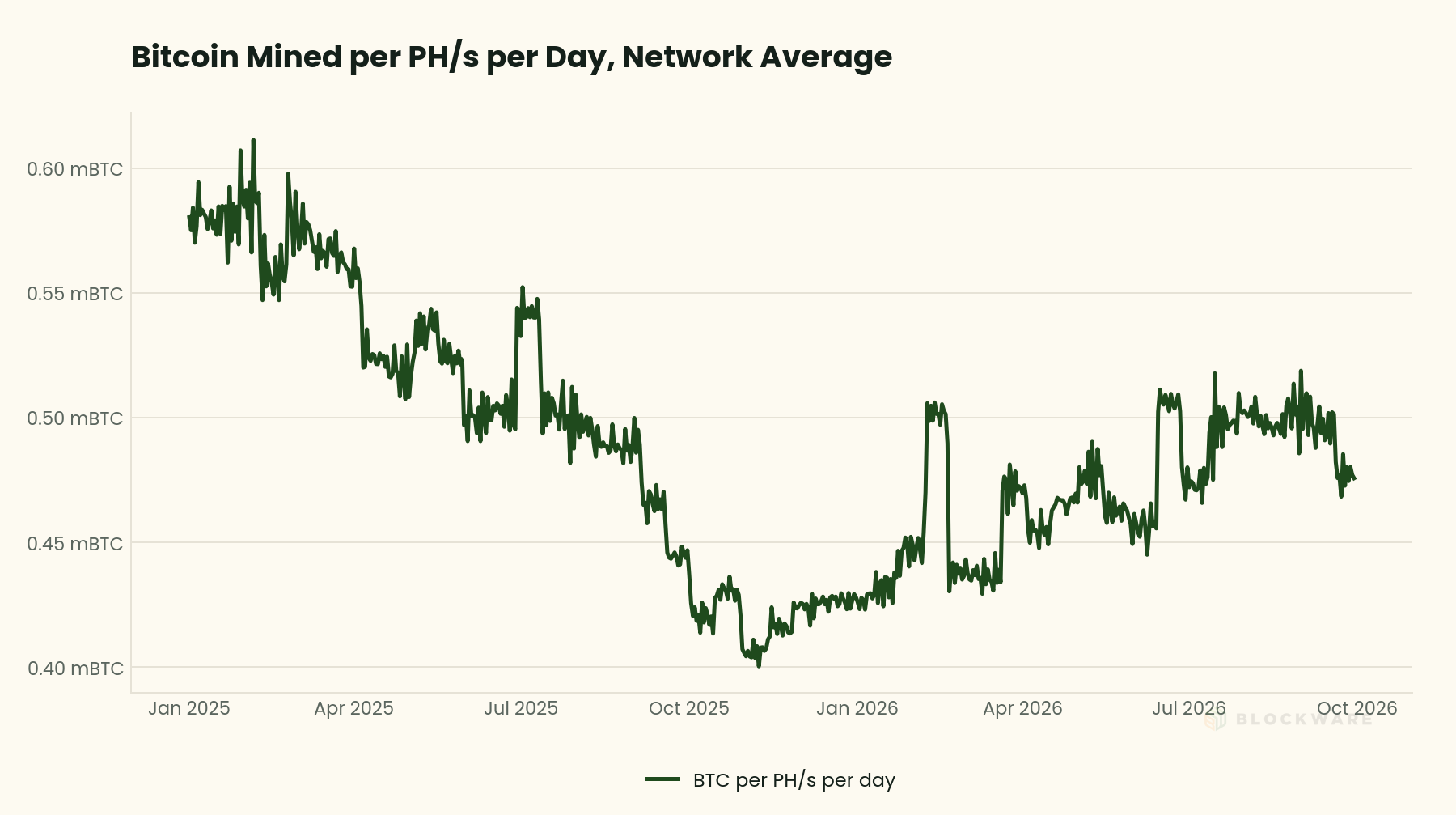
Each unit of hashrate earns 19% more Bitcoin than it did in November. Network-average production per PH/s per day bottomed on November 8, 2025 and has risen with the drop in difficulty.
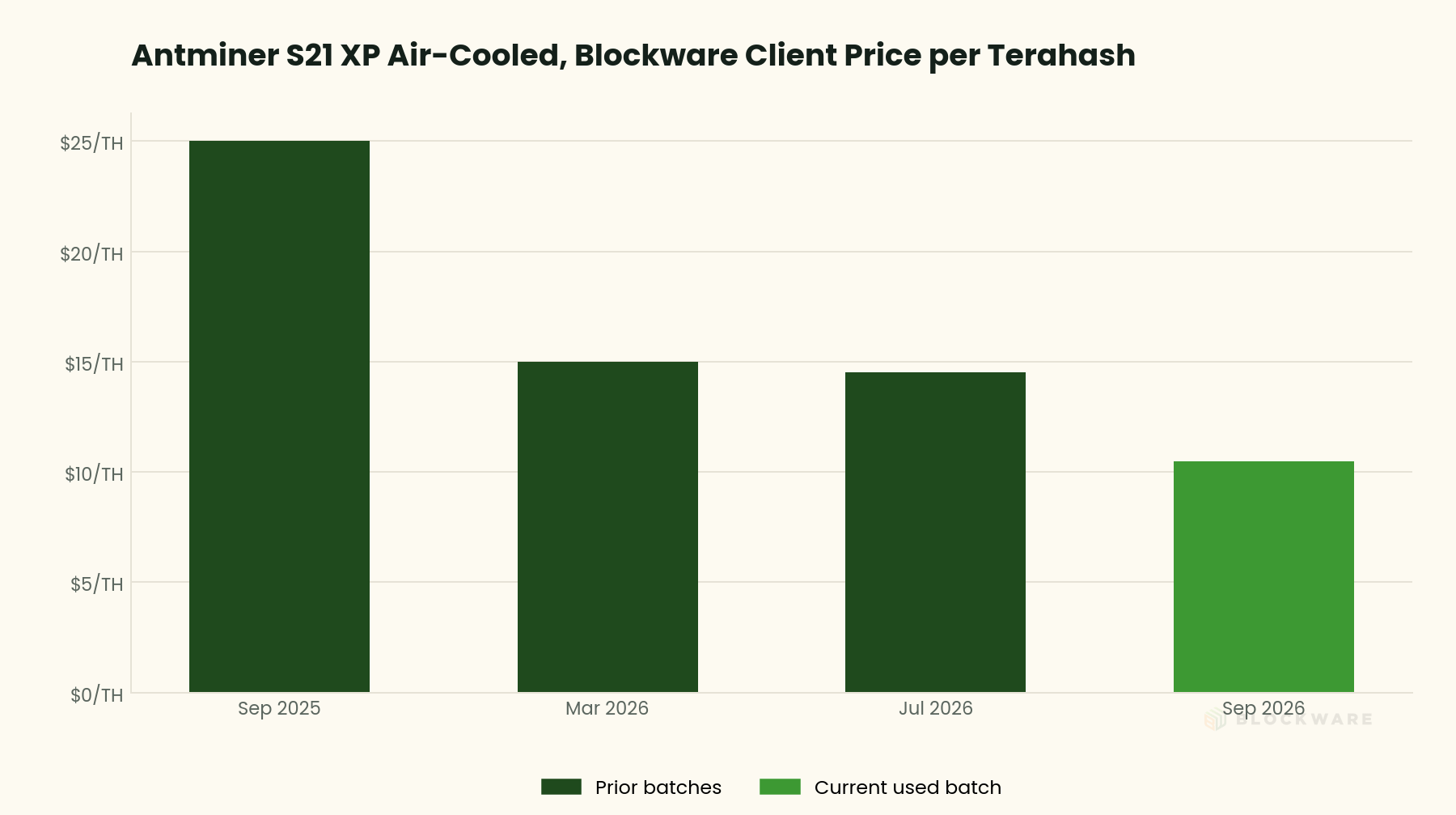
The S21 XP now trades at $10.50 per terahash. A year ago the same machine cost $25/TH. Decommissioned public miner fleets are increasing the supply of ASICs on the market.
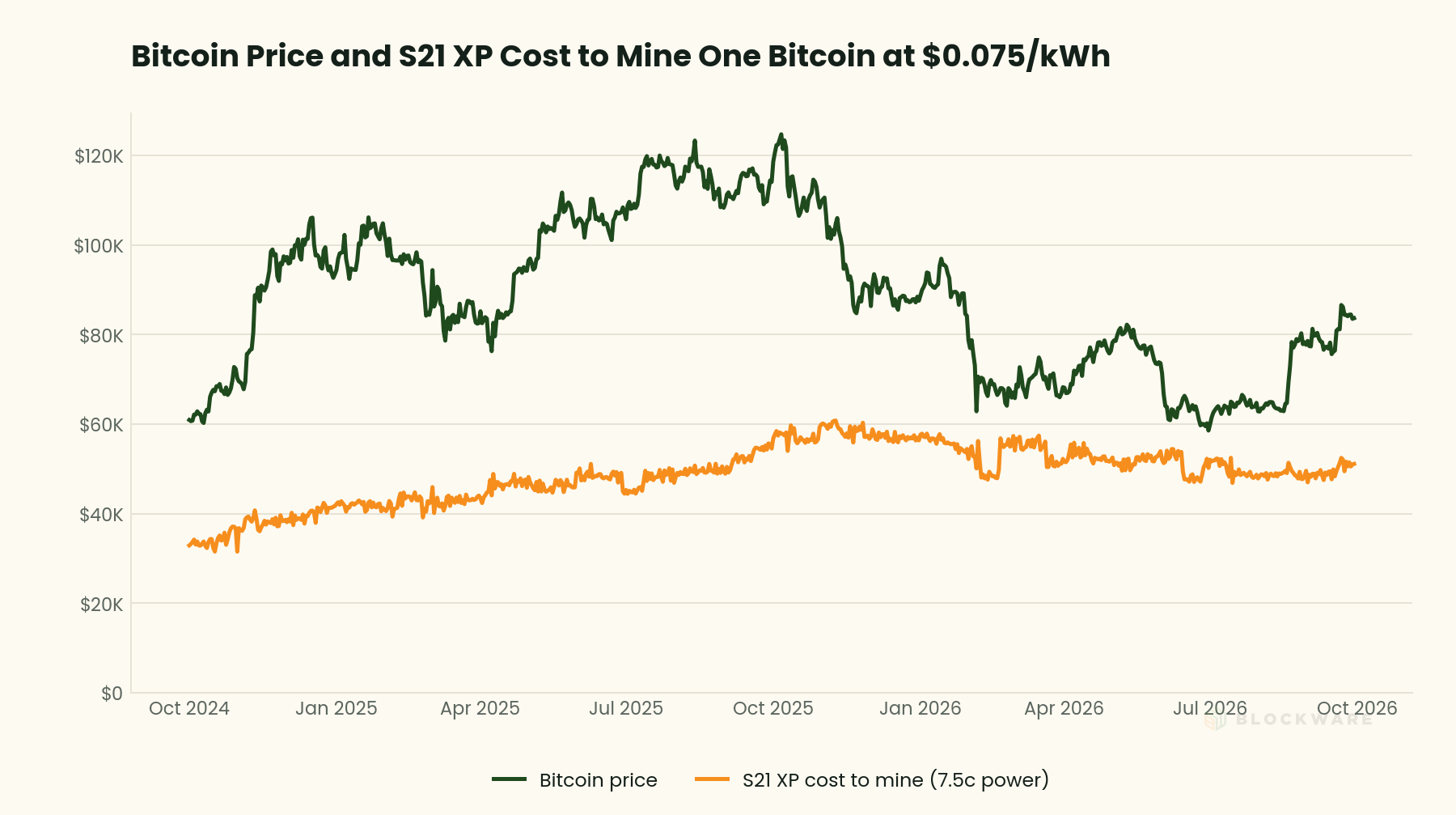
Bitcoin breakeven price / “Cost to mine” is $51,000 for miners with 7.5 cent power. At today’s difficulty an S21 XP produces a coin for ~40% below the spot price.
The 14-day average hashrate peaked at 1,134 EH/s on October 25, 2025 and has drifted lower for eleven months. It sits at 946 EH/s today, 17% below the peak. Outside of the 2021 China ban and the weeks following a halving, the network has never shed hashrate for this long. The difference this time is that nobody was forced off. The operators that left chose to redeploy their sites.
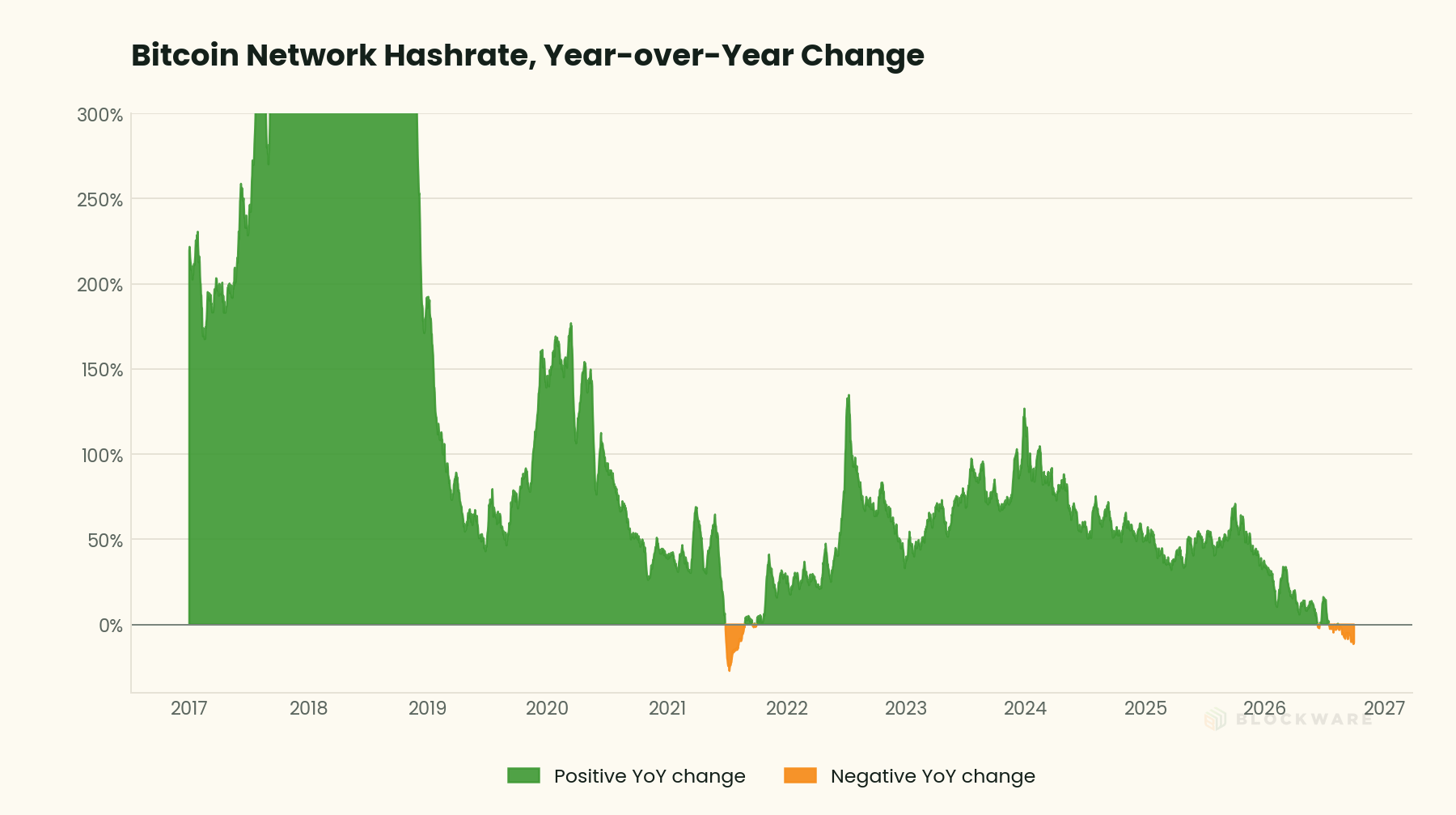
Hashrate is down 10.5% from a year ago. That is the second negative annual reading in Bitcoin’s history, and the first that wasn’t caused by a government ban. For most of the last decade the network grew 30 to 100% a year, and in the early years it grew by multiples. The chart shows how far outside the historical range the current regime is. Every exahash that leaves is a larger share of the block reward for the machines that stay.
Riot Platforms signed a $9.1 billion, 20-year lease with Anthropic on August 11 covering 191 MW at its Rockdale, Texas campus, one of the largest Bitcoin mining sites in the world. IREN has $9.7 billion with Microsoft, Core Scientific $10.2 billion with CoreWeave, TeraWulf $12.8 billion across counterparties, and Hut 8 a $7 billion deal with Fluidstack that Anthropic anchors. Disclosed contracts across the listed miners now exceed $70 billion, and the sector expects AI to be roughly 70% of its revenue by year end. A Bitcoin mining data center is energized land with a grid connection and cooling, which is most of what an AI tenant needs. A fixed-rate, decade-long contract from an investment grade counterparty is hard for a public company to turn down at any Bitcoin price.
Difficulty peaked at 156T on October 29, 2025 and is 132.8T today, down 15%. February’s -11.2% adjustment and June’s -10.1% are the two largest downward moves since the 2021 ban. Difficulty is the mechanism that converts a thinner network into more Bitcoin per machine. With new data center capacity being built for AI rather than mining, the usual source of difficulty growth has slowed.
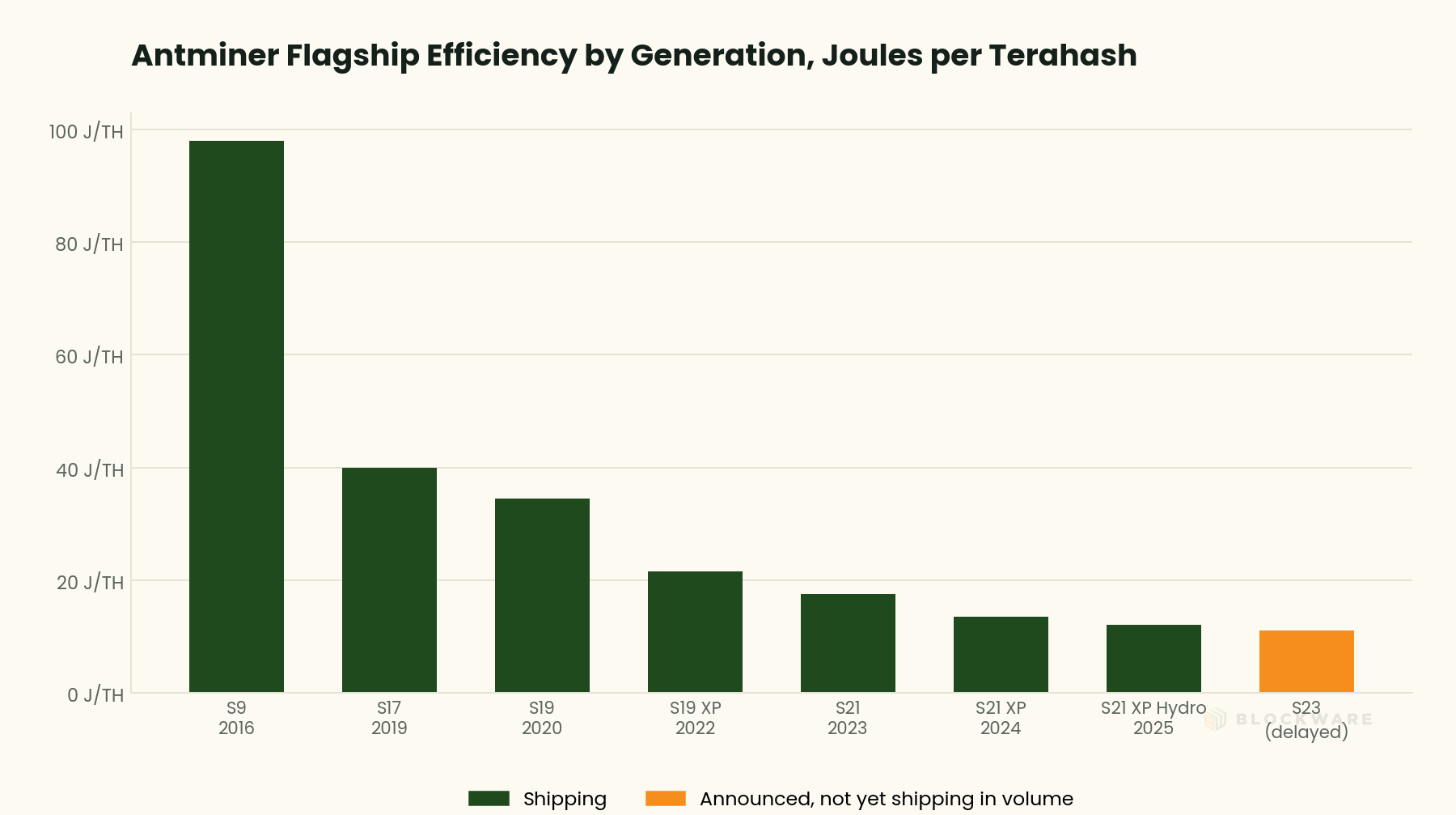
Another reason mining difficulty will likely grow much slower (if at all) going forward has to do with the diminishing marginal efficiency gains of new machines. From the S9 in 2016 to the S19 XP in 2022, each Antminer generation cut energy per hash by 15 to 60%. The last two steps were about 20% each, and the announced S23 improves on the S21 XP Hydro by under 10%. The air-cooled S23 was slated for early 2026 deliveries and has yet to ship in volume. TSMC and Samsung allocate leading-edge wafers to Nvidia and the AI labs first, and Bitcoin ASIC manufacturers are a small customer by comparison.
The practical effect is that an S21 XP in service today faces less meaningful competition for the foreseeable future. As such, mining difficulty will likely increase at a much slower rate going forward compared to historical growth rates.
Used Antminer S21 XP (270 TH/s) are available through Blockware at $2,835 per unit, or $10.50 per terahash. The same model sold at $25/TH in September 2025 and around $15/TH through the spring and summer. Excess supply is coming from public miners decommissioning current-generation fleets as they convert sites to AI. This influx of supply has pushed miner prices down despite BTC rebounding ~40% from it’s June 30th low.
Network-average production per PH/s per day bottomed on November 8, 2025 and is up 19% since. This is the direct result of the difficulty decline, and it is why machines deployed earlier this year are producing more BTC than projected. A 270 TH machine that mined 0.0033 BTC a month at the November low mines about 0.0039 BTC a month today.
At 7.5 cent power and today’s difficulty, an S21 XP consumes about $51,000 of electricity per Bitcoin produced. With Bitcoin at ~$84,000, each coin arrives at a ~40% discount to spot on an operating basis. The current gap between the price of Bitcoin and the cost of production for miners it’s the widest since early 2025.
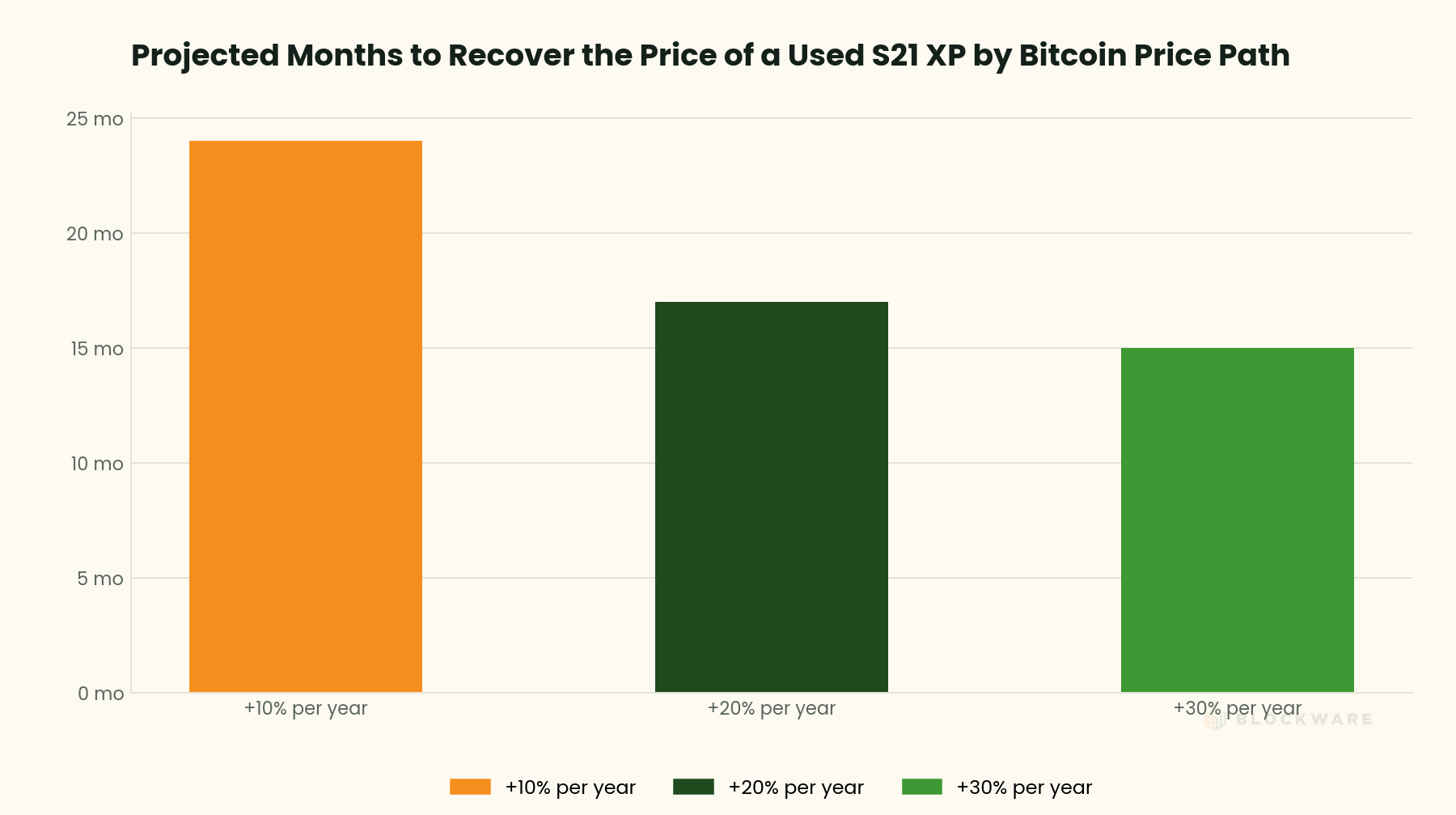
Lower mining difficulty, a rising BTC price, and cheaper machine prices are 3 forces working in favor of Bitcoin miners. This combination has drastically lowered the amount of time needed to recoup the cost of machines. If BTC goes up ~20% per year for the next 2 years (~$120k in 2028; very conservative in our opinion) then Antminer S21 XPs will pay for themselves in ~16 months; and this doesn’t even factor in any tax savings generated through bonus depreciation.
The largest and most efficient miners are leaving the network because AI pays more for the same site, and they are selling their machines on the way out. For the operators who stay, that means more Bitcoin per machine, cheaper hardware, longer competitive life for current-generation units, and slower difficulty growth than any prior cycle. Blockware hosts Bitcoin miners at 8 different facilities across the United States; enabling anybody to capitalize on this opportunity.
To place a bulk order ($50,000 or more), contact sales@blockwaresolutions.com or your Blockware account rep directly. For more information, download our free Bitcoin Mining Guide here: blockwaresolutions.com/info
Not tax, legal or investment advice. Projections are model outputs and depend on Bitcoin price, network difficulty and uptime.