


Download your FREE personal cybersecurity guide from The Bitcoin Way and secure your digital life.

When STRC IPO’d in July 2025, I believed three things to be true:
STRC would maintain a share price of $100.
STRC would allow Strategy to raise capital during bear markets, avoiding the need to issue MSTR when the stock isn’t trading at a premium to Net Asset Value.
STRC would funnel new pools of capital into the Bitcoin ecosystem by being accessible to portfolios with fixed income mandates.
So far, none of these things are true.
I want to be clear about what this piece is and what it isn’t. STRC is not inherently a bad asset. It’s a legitimate financing instrument that does real work for the corporation. The problem is that expectations were set for something it was never structurally capable of being. Overpromised, underdelivered. A meaningful share of the blame sits with the language used to market it. Furthermore, the shortcomings of STRC are being paid for by common stock shareholders through dilution.
1. There was never a peg
Part of the pitch was that Strategy was building a yield curve on top of Bitcoin, with STRC serving as the equivalent of T-bills or a money market fund. Short duration. Low interest rate sensitivity. Capital recoupable at any time.
Legally, STRC is the furthest thing from a short-duration liability. It’s perpetual. Perpetual is the antonym of short duration. There is no contractual requirement for Strategy to ever return the capital that STRC holders invested.
This is where the “digital credit” label falls short. It’s an inaccurate term for describing this product, and once you accept the term, you inherit a set of expectations the instrument cannot meet.
Consider what actually makes real credit behave the way it does. A bond has a fixed date on the calendar, established by legal contract, on which the issuer must return principal. That single feature is what drives the pricing behavior everyone associates with fixed income. As the maturity date approaches, the price becomes progressively less sensitive to changes in interest rates, issuer liquidity, and credit spreads, because there is progressively less uncertainty about repayment. The date is a gravitational pull toward par.
Long-duration credit behaves the opposite way. More time to maturity means more uncertainty about repayment, which means higher price volatility for any given change in rates or credit conditions.
STRC is as long-duration as duration can get. Infinite. And it’s somehow expected to trade like a money market fund.
So what actually holds the price near $100? Not a peg. “Par” is an arbitrary index value that exists to quantify the yield. When Strategy says the dividend is X%, the only thing that percentage is a percentage of is a $100 stated amount. Par is the denominator, not a promise.
In practice there are two mechanisms, and they’re asymmetric:
On the upside, Strategy can effectively stand as a perpetual ask at $100. If the price wants to run above par, the company issues more STRC into that demand. This works. It’s why STRC held par through underlying BTC price action.
On the downside, there is no equivalent. Nothing in the structure forces a bid at $100. The only tools available are discretionary: raise the dividend rate, buy shares back in the open market, or increase the dividend reserve (by diluting MSTR or selling BTC; both of which decrease BTC per Share). All 3 of these “tools” come out of the pockets of common shareholders (more on this below)
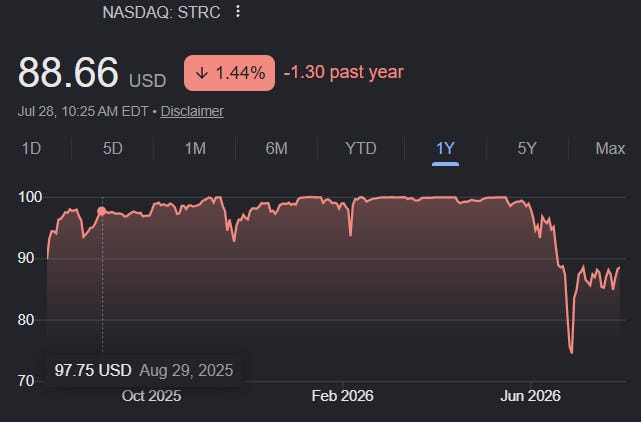
The asymmetry is measurable, and on the upside it’s absolute. Across STRC’s first 252 sessions, the highest close was $100.07. Not one session closed above $100.10, and 35 sessions closed pinned inside the ten-cent band just above par. Against that, 53% of sessions closed below $99, 12% closed below $90, and the low print was $74.57 on June 26, 2026.
Maximum upside overshoot: seven cents. Realized downside: twenty-five dollars and forty-three cents.
Run the sensitivity to Bitcoin and the ceiling shows up in the coefficients. When STRC sat at or above $98, its beta to Bitcoin on up days was statistically indistinguishable from zero while its down-day beta stayed positive and significant. Bitcoin rallied 2% or more on 23 of those sessions and STRC moved an average of 0.21%. The largest gain in that entire group was 1.04%.
Once STRC broke below $98, the asymmetry vanished and beta quintupled in both directions. There’s no ceiling below par, and there was never a floor.
And the first tool has already been tested. The dividend rate went from 9.00% at launch to 12.00% by July 2026, raised eight separate times, up 300 basis points in twelve months. Over that same window the price went from $89.95 to $88.32 and low-ticked $74.57. Strategy raised the coupon by a third and the instrument still lost a quarter of its value. Whatever the variable rate mechanism is for, defending par in a drawdown isn’t it.
The both-sides-of-the-ball problem
Strategy’s defenders tend to argue two incompatible positions depending on which side of the trade they’re describing.
A liability of perpetual duration is objectively excellent for a corporation. Fiat debases, and the liability gets easier to service in real terms every year. Capital you never have to return is the best capital there is. In this respect STRC is a genuinely great tool for Strategy. If I could borrow and never repay principal, I would too.
But you can’t hold that position and simultaneously describe STRC as money-market-equivalent.
When advocating for the corporation: look how great this is, they can borrow without ever returning the capital.
When advocating for STRC: look how great this is, you get a high yield and you can get your money back anytime.
Both of those cannot be true. The feature that makes STRC valuable to Strategy is precisely the feature that disqualifies it as a cash equivalent.
The Sharpe ratio was measuring the intervention
This deserves its own treatment, because the Sharpe ratio became Strategy’s headline proof that STRC was working.
On March 11, 2026, Saylor posted that STRC had crossed a Sharpe ratio of 3, with a chart showing 3.08 and STRC ranked above Alphabet, Nvidia, Tesla, and the S&P 500. By April, third-party coverage put the figure at 4.53 on 1.7% thirty-day volatility. On the Q1 2026 call, management described the goal as building the most stable, least volatile, highest Sharpe ratio credit instrument in the world, and worked through comparisons against junk bonds, investment grade, bank preferreds, the S&P, the Nasdaq, the Magnificent Seven, and hedge funds. They gave a target range of $99 to $101 and noted STRC had sat inside it 100% of the time across March, April, and May.
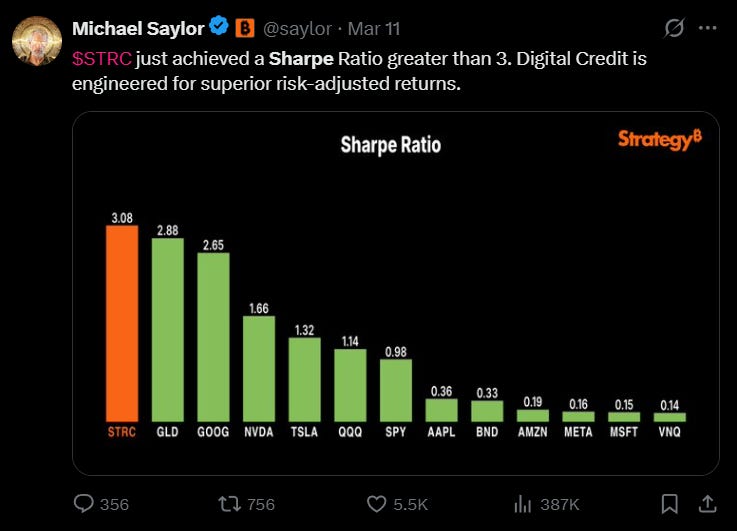
STRC IPO’d in July 2025 on a pitch about yield and stability. The Sharpe campaign arrived eight months later, after volatility had been compressed. The metric was retrofitted once it became flattering.
Here’s the arithmetic problem. A Sharpe ratio of 3 on an 11.5% coupon requires roughly 3% annualized volatility. There is no other way to reach that number. So the ratio was, mechanically, a measurement of how successfully Strategy was suppressing the variance of its own instrument. The company sets the coupon. The company was managing the price at par. Both inputs to the ratio were company-controlled.
Then look at what happened to the denominator once the defense stopped working. Thirty-day annualized volatility by month end:

The trough was 1.65% on May 14. The peak was 53.81% on July 20. That’s a thirty-fold increase in nine weeks. If the low volatility had been a property of the instrument, it would have survived contact with a Bitcoin drawdown. It didn’t.
Now the full year, on Strategy’s own dividend schedule. Thirteen dividends totaling $10.94 per share, a price move from $89.95 to $88.32, and the risk-free rate averaging 3.83% on 13-week T-bills:
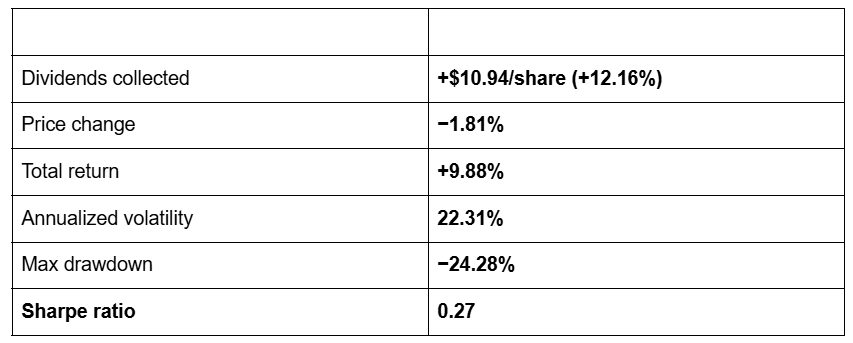
Bitcoin over the identical sessions returned negative 46.74% for a Sharpe of −1.18. STRC on price alone, stripping out the coupon, was −0.25. Every dollar of positive return was the dividend.
So holders earned twelve percent in cash, gave back two percent in price, cleared six points over T-bills, and sat through a 24% drawdown to collect it. That is the realized profile of the instrument marketed as the short-duration layer of a Bitcoin yield curve.
Sharpe ratios need years of data to mean anything. With one year, the standard error on an annualized Sharpe is roughly 1.0, so my 0.27 carries a confidence interval wide enough to contain much better outcomes. But that same arithmetic is what destroys the marketed figures. A Sharpe of 3.08 estimated from a single month of returns carries a standard error of about 8. It cannot be distinguished from zero, or from twenty. Publishing it as evidence of engineered risk-adjusted performance was never statistically supportable, in either direction.
2. The bear market tool is being used for the opposite of its purpose
This is the part that actually costs shareholders money.
The historical playbook. In bull markets, MSTR has traded at a premium to the value of Strategy’s Bitcoin holdings. That premium created a genuinely accretive machine: issue MSTR above NAV, use the proceeds to buy Bitcoin, and BTC per share increases. Every shareholder ends up owning more Bitcoin than they did before, despite owning a smaller percentage of the company. Until 2025 this was Strategy’s primary purchasing tool, alongside convertible notes.
The limitation of that playbook. It only works when the stock trades at a premium, and the stock only trades at a premium in bull markets. Which raises the obvious question: how do you grow the Bitcoin position during a bear market?
That question matters more than the bull market case, because by definition Bitcoin is cheaper in bear markets. If your primary capital-raising tool is only available when Bitcoin is expensive, you are structurally forced to buy high.
This is why Strategy has been buying Bitcoin for nearly six years and carries a cost basis around $75,000.
Enter STRC. An instrument that raises capital regardless of mNAV. Capital available in the exact conditions the equity machine goes offline. Their own Q3 2025 guidance said as much.
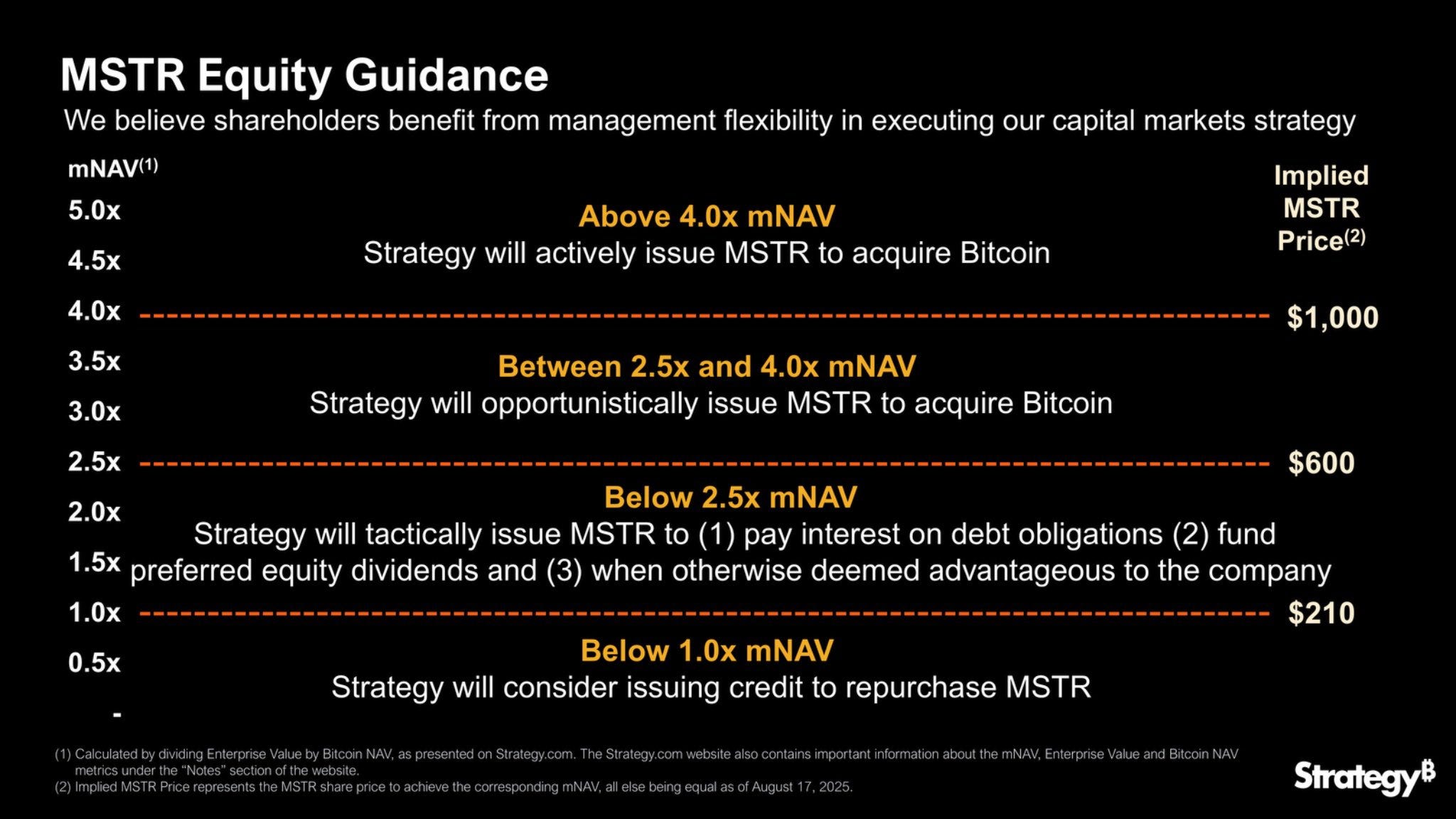
What’s actually happening one year later. Strategy is issuing MSTR and using the proceeds to buy back STRC, in an attempt to push it toward the arbitrary $100 level.
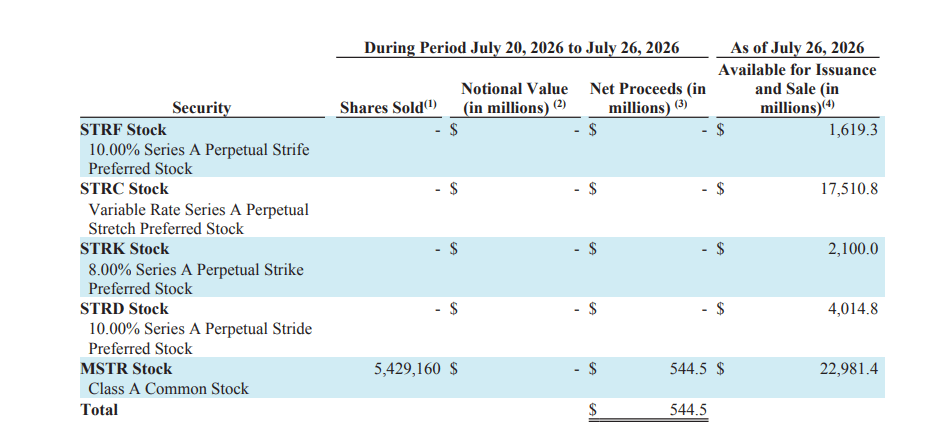
The instrument was created to raise capital so the company could buy Bitcoin when Bitcoin is cheap. The company is now diluting common shareholders to defend the price of that instrument, during precisely the period when Bitcoin is cheap. The tool built to solve the bear market problem has become the bear market problem.
The mechanics are not ambiguous. When you issue MSTR and buy Bitcoin, BTC per share rises or falls depending on whether you sold equity above or below NAV. When you issue MSTR and retire preferred stock, the Bitcoin stack doesn’t move and the share count goes up. BTC per share falls. Unconditionally. There’s no price at which that transaction adds a single sat to the per-share number.
And you don’t have to read between the lines on intent. Public statements from both Michael Saylor and Phong Le have confirmed that the priority is not:
increasing BTC per Share
creating value for MSTR shareholders
increasing the Bitcoin position

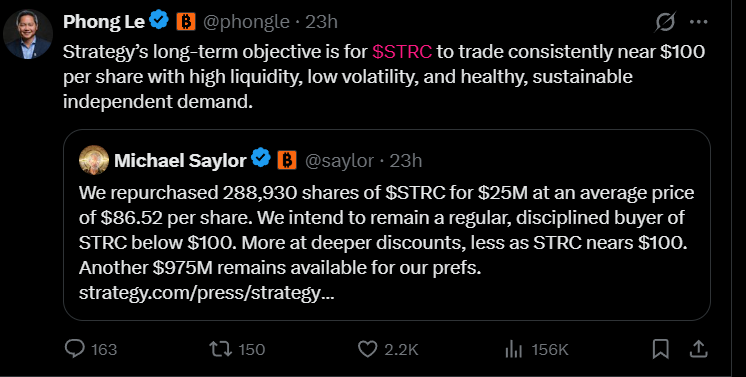
The priority is supporting STRC. Getting STRC back to $100.
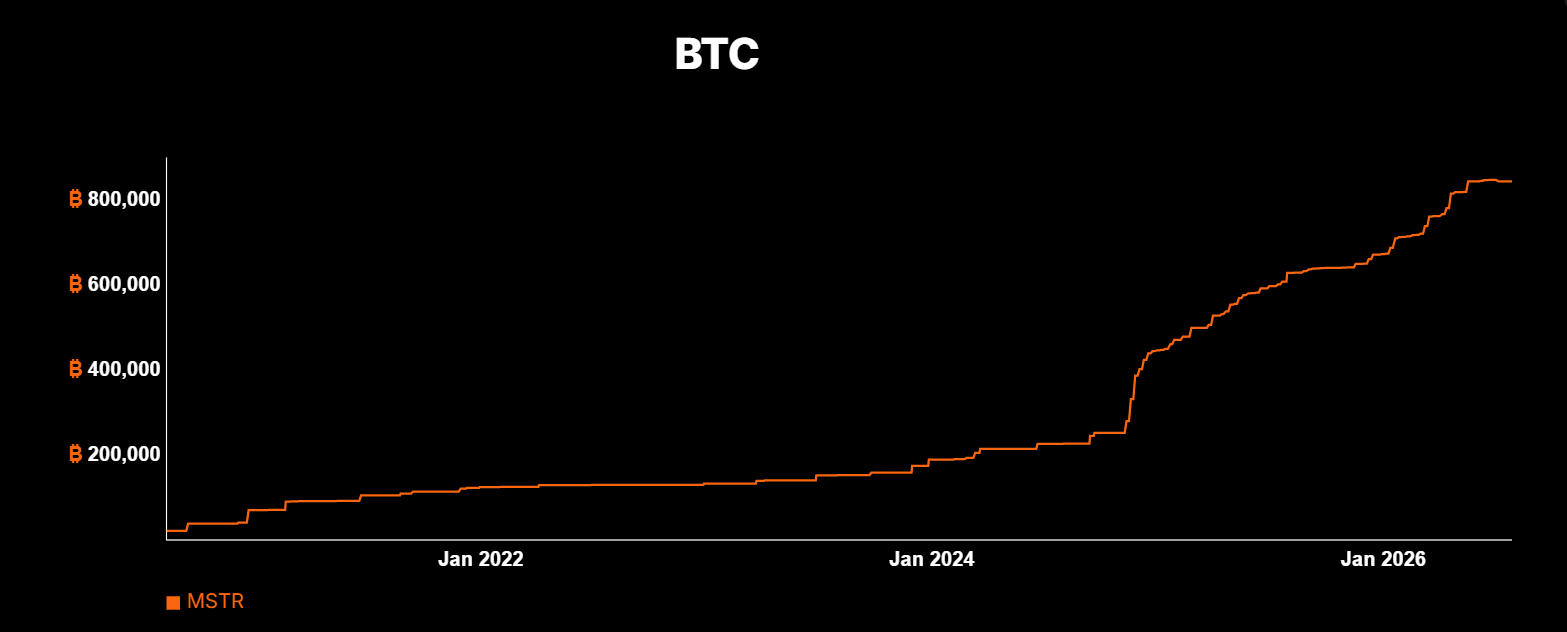
Over the past two months, this has come at the expense of BTC per Share and BTC Yield; their once flagship KPIs.
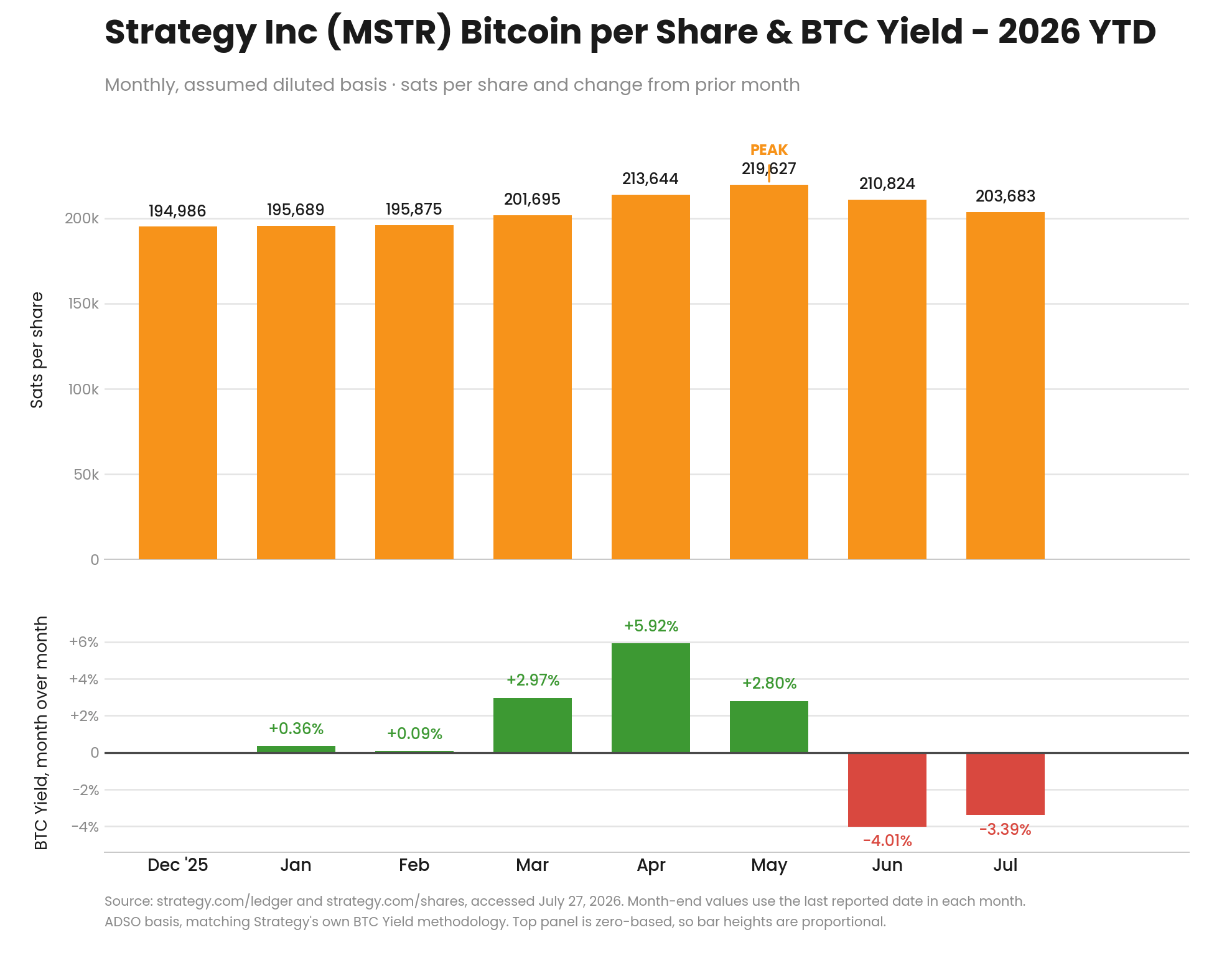
Per-share Bitcoin rose in every month from January through May, peaking at 219,627 sats, up 12.64% from the December 2025 base. Then June came in at negative 4.01% and July at negative 3.39%. Compounded, that’s a 7.26% drawdown from the peak in two months. It has erased the entire Q2 gain and returned per-share Bitcoin to roughly where it sat in March.
Two consecutive negative months, on the company’s own flagship metric, while Bitcoin trades at a discount to where they’ve bought most of their stack. That is the cost of the STRC defense, denominated in the KPI Strategy spent the past 6 years inoculating the market to observe.
3. The fixed income capital has not shown up
The third belief was that STRC would pull new capital into Bitcoin. Capital sitting in fixed income mandates that couldn’t or wouldn’t buy spot BTC, an ETF, or MSTR common, but could hold a yield instrument. Expanding the buyer base rather than recycling the existing one.
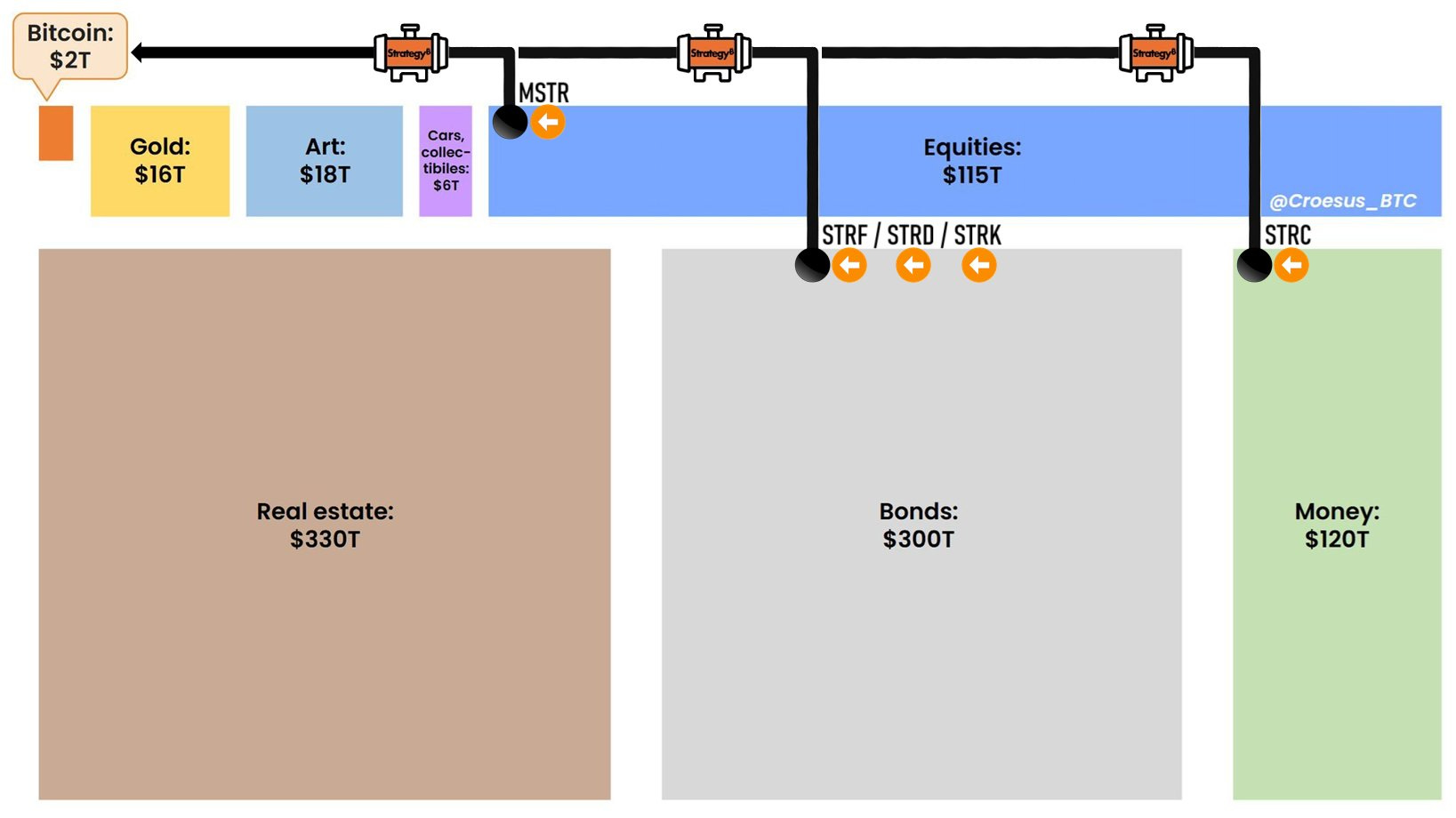
Part 1 already explains why this was never realistic. A credit allocator screens on a short list of hard requirements, and STRC fails most of them:
No maturity date. A perpetual has no defined duration, which means it cannot be slotted into a duration-managed portfolio. This is a threshold test, not a preference.
Issuer-set coupon. The dividend rate is adjustable at the company’s discretion. No fixed income buyer accepts an instrument where the issuer controls their yield.
Ratings and index eligibility. S&P rated Strategy B- in October 2025, five notches below the lowest investment grade. That's an issuer rating, and it doesn't attach to STRC. Preferred stock gets its own issue-level rating through notching, typically several steps below the issuer, which from B- means CCC territory. STRC carries no agency rating at all, which is why Strategy invented a proprietary "BTC Rating" and disclosed in its own footnotes that the metric isn't equivalent to a rating in the traditional sense. Even a rating wouldn't help. Bond benchmarks require a maturity, and the main fixed-rate preferred indices require a dividend that's actually fixed. STRC fails both by construction.
Single-asset collateral. The coverage behind the dividend is one asset with a documented history of 70%-plus drawdowns.
So who actually owns it? Roughly 80% of STRC holders are retail, against about 40% for MSTR common. The instrument built to reach fixed income mandates ended up with a holder base twice as retail as the common stock it was supposed to protect from dilution.
That single number explains the price behavior. Retail yield buyers who found STRC through Bitcoin are already long Bitcoin. They’re not a net-new holder base. They’re the same pool of capital; correlated to the exact asset the instrument was supposed to be insulated from. When Bitcoin drew down, the marginal STRC buyer was drawing down too, so the bid disappeared at the same moment it was needed.
New pools of capital were not unlocked by this product. An existing pool of Bitcoin retail investors rotated in.
All three defense mechanisms victimize the common stock. Raising the dividend rate increases the recurring cash obligation, which is ultimately funded by equity issuance or Bitcoin sales. There is no version of defending STRC that common shareholders don’t pay for.
And the loop is potentially reflexive:
mNAV falls below 1.
The equity cushion sitting above the preferred shrinks in market terms, so the preferred looks riskier.
To defend the preferred, the company issues common at a discount and buys preferred back.
That issuance lowers BTC per share, which confirms the market’s reason for applying a discount, which pushes mNAV lower.
Return to step 2.
There are two exits. Bitcoin appreciates enough to fix the numerator, which is entirely outside management’s control. Or the company stops defending par and lets STRC trade where the market puts it, accepting a repricing in exchange for stopping the bleed.
They’ve chosen neither. They’ve chosen to fight step 3 with shareholder equity, which is the one lever that feeds step 4.
What would change my mind
Here’s what I’m watching:
BTC per Share turns positive again and stays there for two or more consecutive months while STRC still trades below par. That would mean the defense is being funded from something other than common dilution.
Buyback pacing tracks the discount rather than the distance to $100. Buying more when STRC is cheaper is capital allocation. Buying more when it’s closer to par is price support.
Management reframes the objective publicly, from defending $100 to opportunistically retiring preferred below liquidation value. Same transaction, completely different mandate, and it would tell shareholders which scoreboard they’re being measured on.
Evidence of an actual credit buyer base. A rating, index inclusion, or credit funds showing up in the filings would mean thesis three was early rather than wrong.
Thirty-day volatility returns to single digits and holds there through a Bitcoin drawdown. Compressed volatility during a rally proves nothing. Compressed volatility while Bitcoin is falling would mean the stability is a property of the instrument rather than a product of the intervention.
Credit where it’s due
Two things deserve acknowledgment.
Strategy has continued to pay every dividend on the preferred stack through the drawdown. That is not trivial. Plenty of levered structures don’t survive their first real test, and honoring the obligation preserves the company’s ability to access that market again.
And they’ve remained a net accumulator of Bitcoin through the bear market. Whatever the per-share math says, the absolute stack has grown in an environment where most balance sheets went defensive.
Bottom line
STRC was pitched as three things: a stable instrument, a bear market financing tool, and a bridge to new pools of capital. It has delivered none of them.
The stability was structurally impossible, because a perpetual has no gravitational pull toward par and the only support mechanisms are discretionary and asymmetric. Zero closes above $100.10 and a low of $74.57 is what an absolute ceiling and a nonexistent floor look like in the data, and the Sharpe ratios marketed as proof of engineered stability were measuring the intervention rather than the instrument.
The bear market tool is now being pointed backwards, with common equity issued to defend the preferred instead of preferred capital deployed into cheap Bitcoin. And the new capital never arrived, because an unrated perpetual with an issuer-set coupon was never going to clear a fixed income mandate.
What’s left is a straightforward transfer. MSTR shareholders are funding STRC’s price. The company’s own headline metric has printed two consecutive negative months and given back the entire Q2 gain to do it.
Thank You. An awesome piece and great conveying of complex concepts. Saylor, and sadly Strategy, are now part of the Wall St, investment, hedge fund, central bank cabal. Attempting to centralise and co-opt BTC. The battle BTC would always have to overcome.
All he had to do was stack BTC and put it into cold storage but....
Great to see high quality criticism of Strategy