



Download your FREE Bitcoin self-custody guide from the Bitcoin Way to learn how to secure your stack properly
RIOT Signs 20-Year, $9.1 Billion Ai Deal
RIOT Platforms ($RIOT) surged in after-hours trading on Tuesday following their press release announcing a $9.1 billion deal “with one of the world’s leading frontier AI labs.” It is widely suspected that the Ai lab in question is Anthropic.

This is an unsurprising trend continuation: large scale Bitcoin miners are pivoting their operations and treasuries into Ai. Not necessarily because Bitcoin or Bitcoin mining itself is a bad idea, rather, the demand from Ai labs for their data center capacity is so strong that they’re willing to pay $9.1 billion over 20 years.
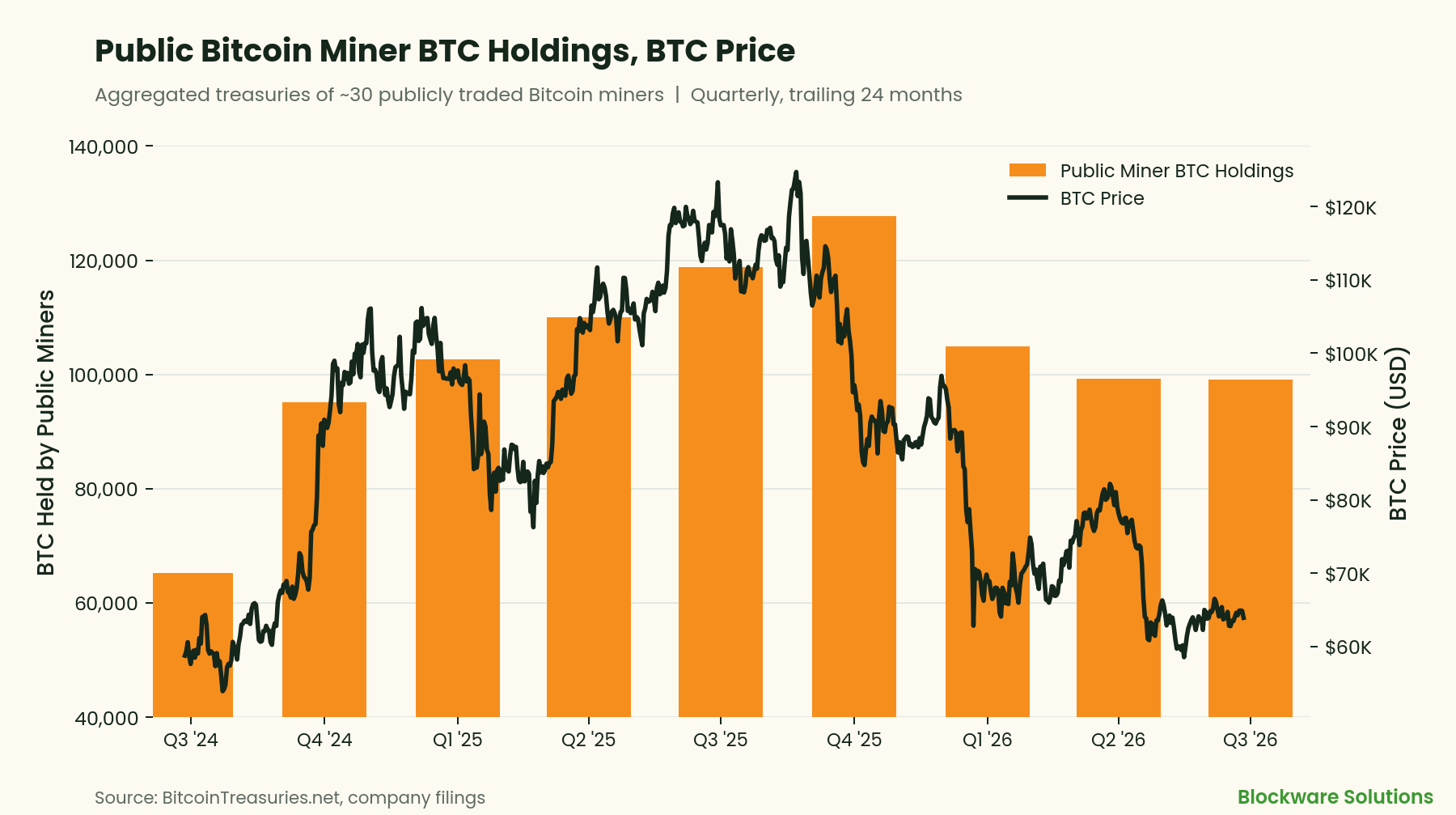
At the start of the year, public miners held a combined ~127,000 BTC but their holdings are down to ~99,000 BTC today. Early year sales from public miners are an underdiscussed contributing factor Bitcoin’s poor price performance in 2026.
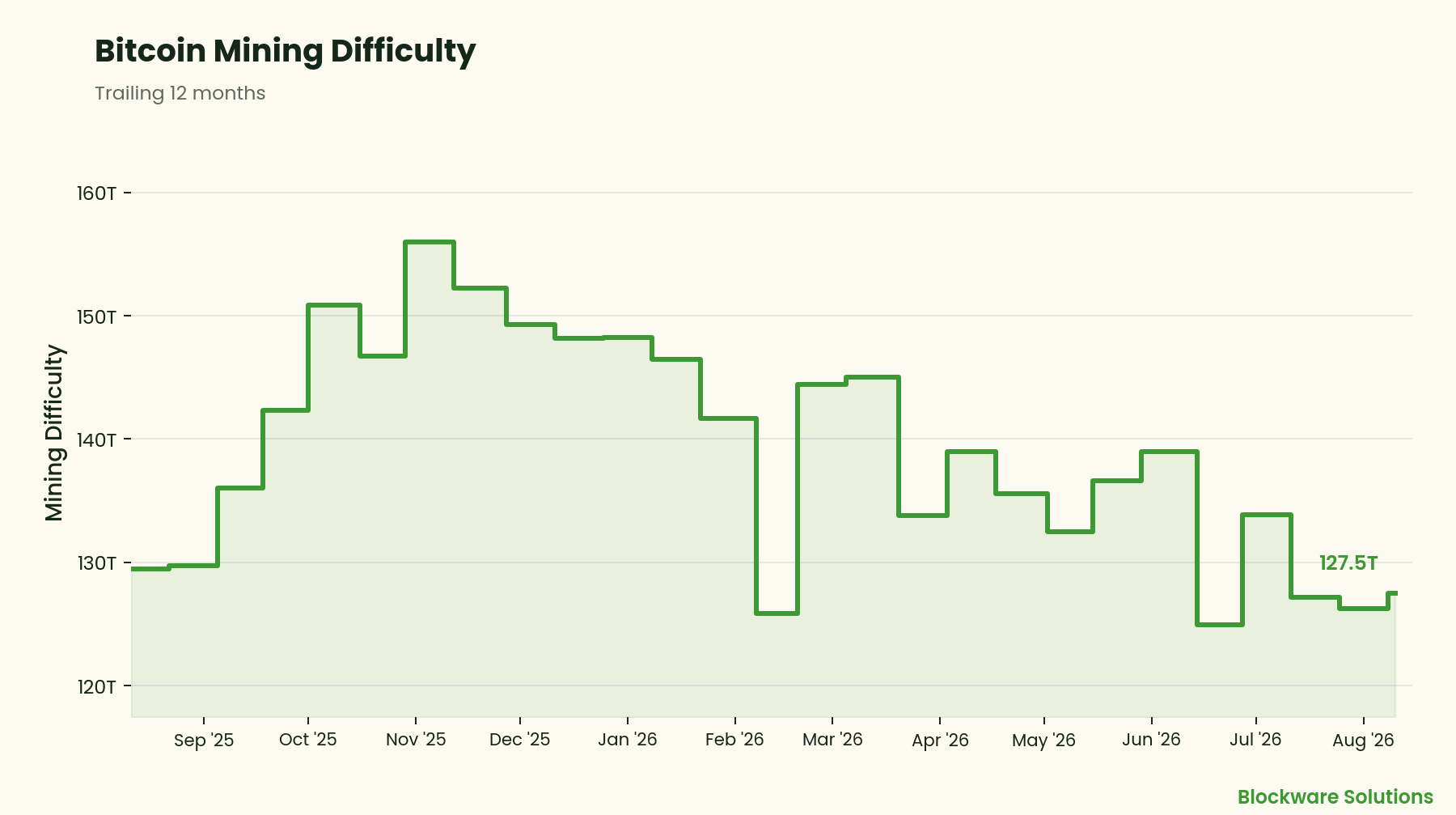
Mining difficulty continues to drop, down ~18% from it’s November peak in the longest stretch of declining hashrate in Bitcoin’s history. In other words, the rest of the miners are earning ~18% more Bitcoin now than they were 10 months ago. The exodus of the largest players in the industry is improving the economics for the miners that remain.
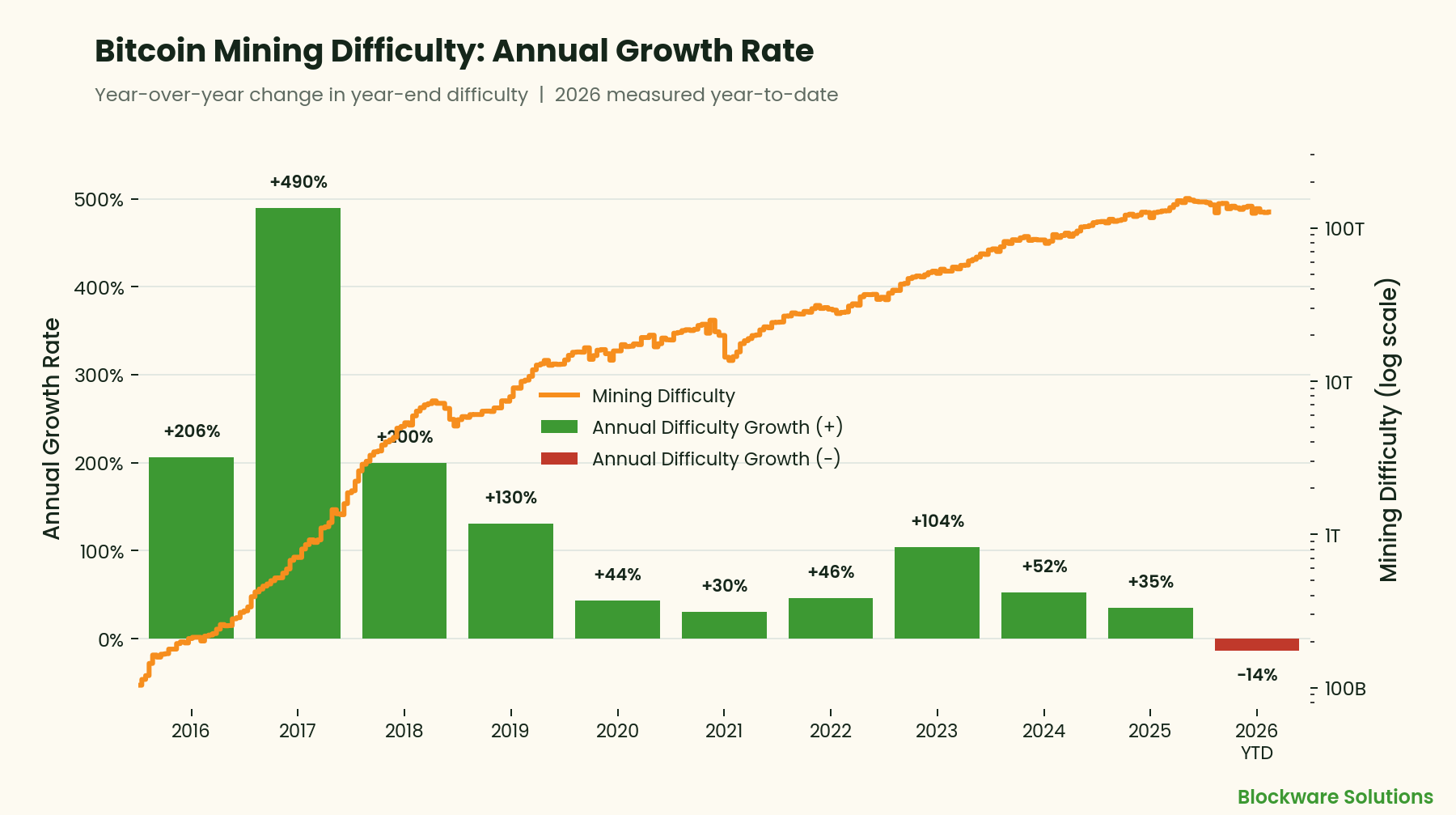
Bitcoin’s total network hashrate is unlikely to repeat the persistent growth rate it experienced for the first 16 years of Bitcoin’s existence.
The Blockware Team has put together a free guide to help you navigate the Bitcoin mining landscape in 2026; covering the how to acquire a 100% tax deduction via Bonus Depreciation and the current economics of a mining machine.
This guide is free to read. Fill out the form here and we will email you the guide.

The important distinction is that this is not simply miners “pivoting to AI.” Bitcoin mining and frontier-model infrastructure monetize the same scarce inputs—power, land, grid interconnection and operating expertise—but they require very different physical and commercial architectures.
Mining is unusually valuable as a flexible load: it can curtail rapidly when power is expensive or the grid is stressed, and its revenue is globally priced in BTC. AI capacity, especially for training and increasingly for production inference, is sold through long-duration contracts with demanding uptime, latency, cooling, network and redundancy requirements. A 20-year AI deal can therefore improve revenue visibility, but it also replaces some of mining’s operational optionality with customer concentration, counterparty risk and technology-cycle risk. The real question is not whether an AI contract carries a larger headline number than mining revenue; it is whether the contracted return still compensates for dedicating power infrastructure to a workload whose hardware and networking requirements can change much faster than a substation’s useful life.
From work with agentic AI deployments, the demand signal is real but heterogeneous. Many enterprise agent systems are inference-heavy and need reliable, geographically appropriate capacity; they do not necessarily require the same large, uninterrupted GPU clusters as frontier training runs. Miners with power access may have a durable advantage, but only where they can convert that advantage into high-quality data-center service—not merely rack space and megawatts.
The decline in public-miner BTC holdings is also worth separating from the hashrate story. Treasury sales can add persistent marginal supply, but lower difficulty improves the economics of the remaining fleet only if their power costs, machine efficiency and financing remain viable. AI conversions may make the surviving mining network leaner, yet they also make Bitcoin’s industrial base less directly exposed to BTC upside and more exposed to a concentrated AI-infrastructure cycle.
The mining difficulty number is the more interesting part for me, not the deal itself. An 18% decline in hashrate from the November peak is the longest stretch like this in Bitcoin's history, so the real question is not whether the big miners are rotating into AI, that part is obvious given what the labs are paying for data center capacity, it is what happens to funding and derivatives positioning once the structural hashrate supply compresses this much. We watch BTC funding on Hyperliquid every day and over the last ten days it has swung by as much as 15 percentage points in 24 hours. Not sure yet if the two are connected but this is the first time I have seen someone lay out the public miner exit numbers this clearly.