


Buying and holding Bitcoin is a position, not a plan.
The plan of the wealthy is to build a system around Bitcoin and other assets to create liquidity, produce income, and fund their lifestyle without selling what they own.
Tomorrow at 6pm EST, Blockware’s partner Mark Moss is hosting a free masterclass to explain his wealth building system. Click here to sign up for free.

The Bond Market Just Broke an 18-Year Ceiling
Global bond yields are at levels most investors under 40 have never traded through. Bloomberg’s global government bond index yields 3.72%, the highest since mid-2008.
In today’s newsletter, we walk through the yield charts, and then answer the question every allocator should be asking right now: what has a 40% bond allocation actually done for you over the past decade, and what happens if you carve out a slice for Bitcoin.
The 30-year Treasury is trading near 5.3%, a level it hasn’t seen since 2007, and the 10-year is at 4.8%, its highest since January 2025.
The market is demanding more compensation to lend to the U.S. government for long durations, and the reasons aren’t hard to find: US & Global M2 at all-time highs, CPI running above target for a fifth straight year, and $40 trillion in debt with more than $1 trillion in annual interest expense.
The treasury doubled its long-bond buybacks on August 19 in an attempt to push yields down. The relief lasted about two weeks. By September 1 the entire move had been erased.
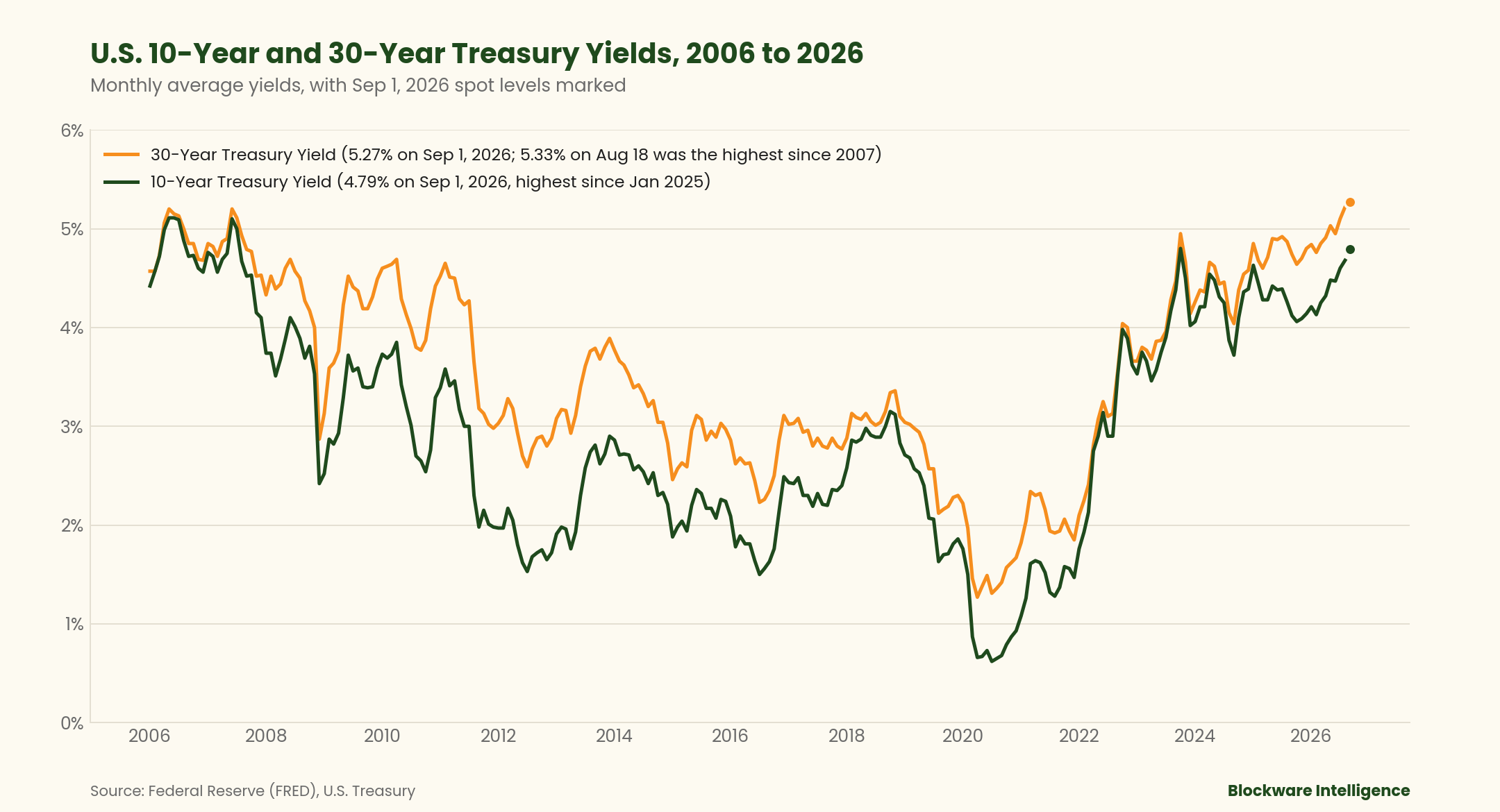
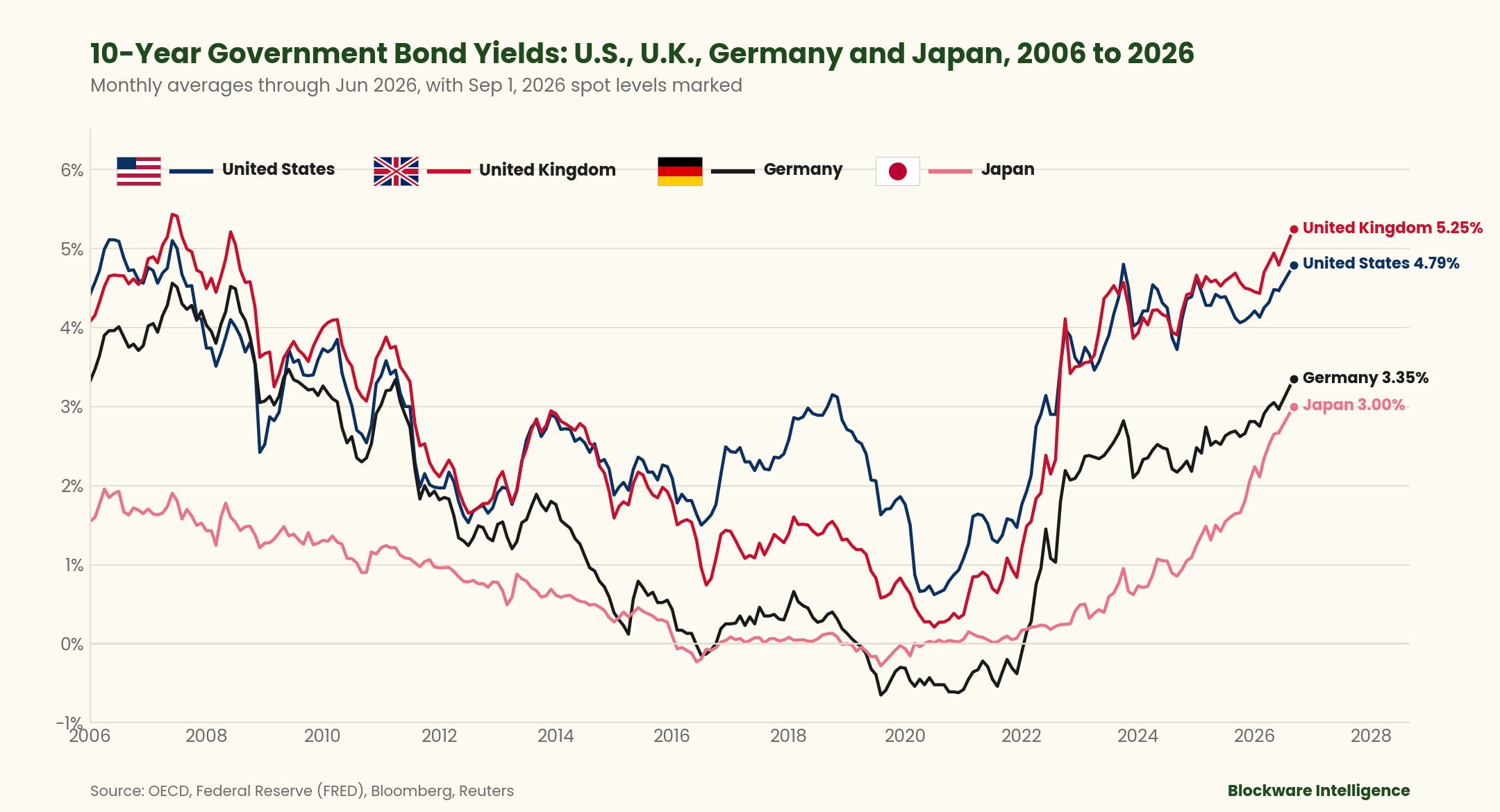
The U.S. 30-year hit 5.33% on August 18, a 19-year high. The 10-year gilt is at its highest since 2008, the 30-year gilt is at its highest since 1998, Japan’s 10-year crossed 3% for the first time since 1996, and the German bund is back at 2011 levels. This is happening in every major jurisdiction at once, which tells you it’s a structural repricing and not a one-country story.
And Japan, which anchored global rates near zero for three decades, now has a 10-year at 3.00% and a 30-year at a record 4.18%. Japanese institutions are the largest foreign holders of Treasuries, and for the first time in a generation they can earn a real yield at home. Every basis point the JGB rises is a basis point less reason for that capital to stay in U.S., U.K. or European debt. The zero-rate anchor that held global yields down since 2009 is gone, and even Fed cuts won’t necessarily bring it back.
Before we get to portfolios, look at what each asset actually did over the past decade:
$1 in the S&P 500 (with dividends reinvested) —> $4.19
$1 in Bitcoin —> $138
$1 in the 10-year Treasury —> $1.01
Ten years of holding the world’s benchmark safe asset returned one percent, total, before inflation. The coupon income was wiped out almost entirely by price losses as yields climbed from 1.6% to 4.8%.
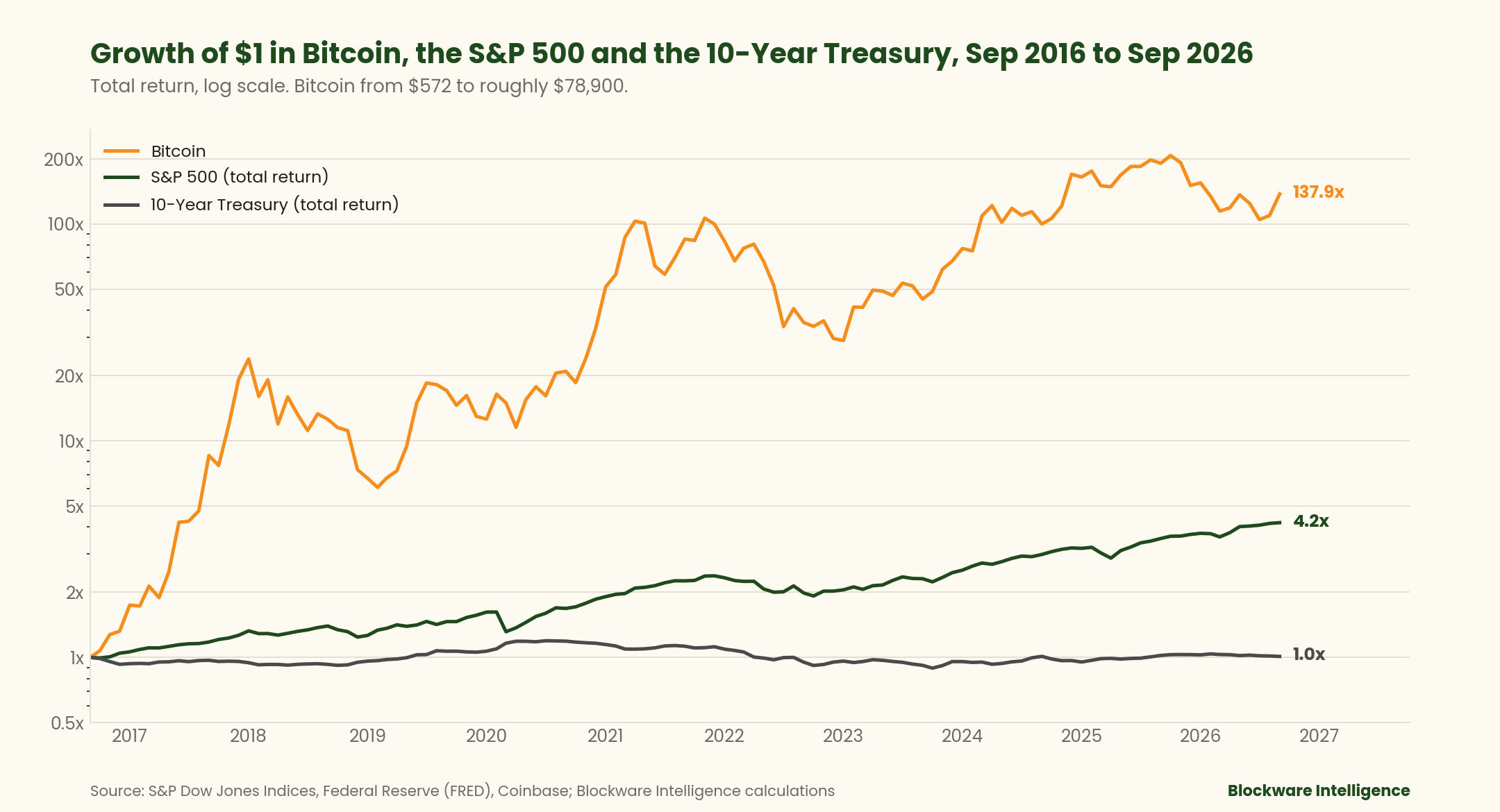
One clarification on the bond number: this is a constant-maturity measure, meaning it holds the 10-year and rolls into the new 10-year every month, which is how a bond fund works and how the bond sleeve of a real 60/40 is actually held, in AGG, BND, IEF or a target-date fund. Those funds mark to market, so every time yields rose from 1.6% toward 4.8%, the coupon got eaten by price losses on the way. If you bought a single 10-year Treasury in September 2016 and held it to maturity, you avoided the mark-to-market and collected your 1.6% a year, about 17% total, plus your principal back this month. Now compare that to roughly 40% cumulative inflation over the same ten years. The buy-and-hold investor lost about a fifth of his purchasing power, the bond fund investor lost that and the price damage on top, and either way the asset that's supposed to be the ballast in the portfolio was the one that quietly lost money for a decade.
And along the way the 10-year suffered a 25% peak-to-trough drawdown, deeper than the S&P 500’s worst drawdown over the same window. The asset that’s supposed to be the “safe space” in the portfolio was the one that lost money for a decade.

Download your FREE Bitcoin self-custody guide from the Bitcoin Way to learn how to secure your stack properly
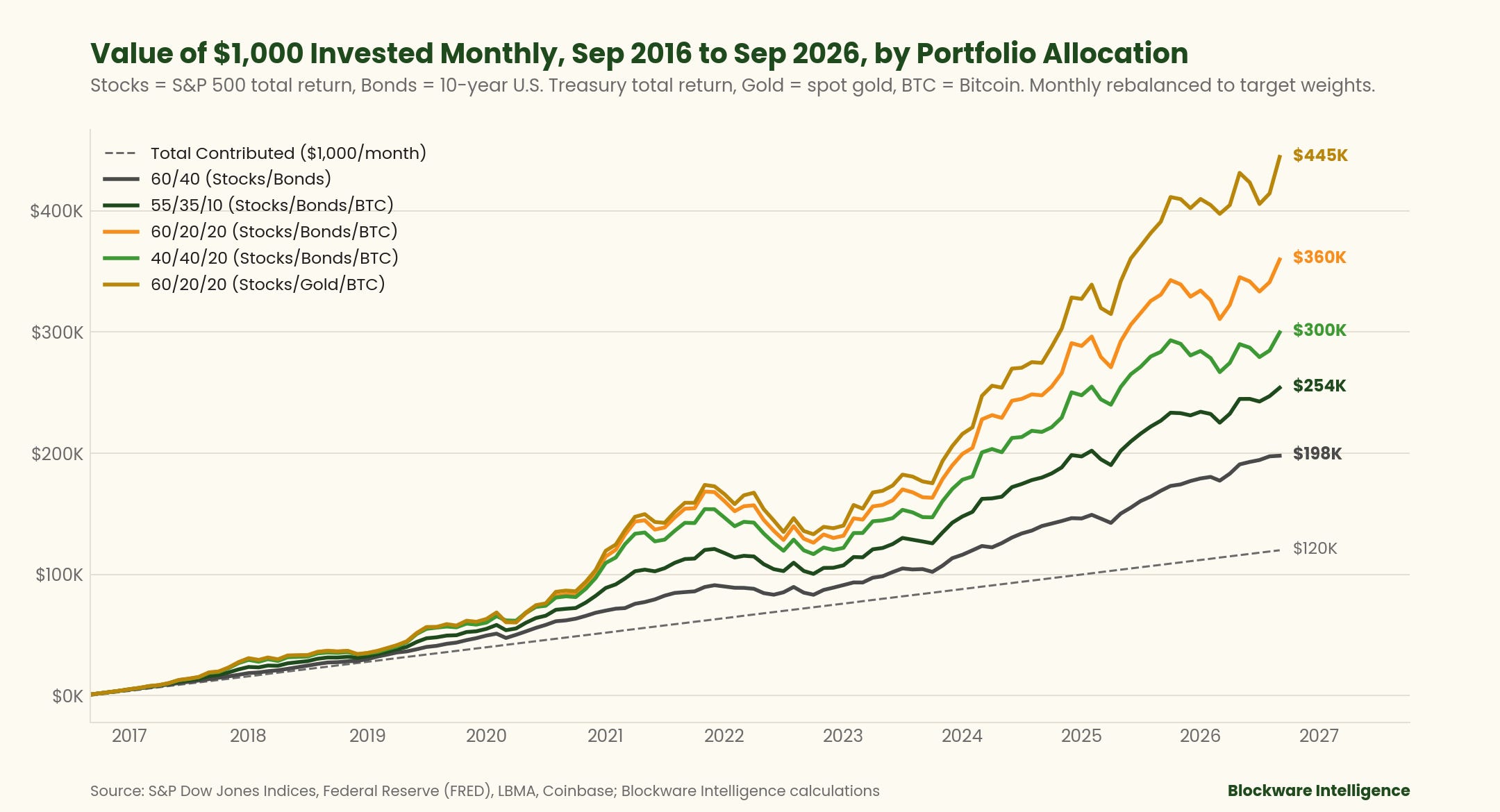
The chart below juxtaposes four portfolios: $1,000 invested on the first of every month for ten years, $120,000 contributed in total, rebalanced monthly to target weights.
Stocks are the S&P 500 total return, bonds are the 10-year Treasury total return, and Bitcoin is Bitcoin.
60% stocks, 40% bonds, 0% Bitcoin: $198,000 (9% IRR, 9% CAGR)
55% stocks, 3% bonds, 10% Bitcoin: $254,000 (14% IRR, 16% CAGR)
40% stocks, 40% bonds, 20% Bitcoin: $300,000 (17%, 22% CAGR)
60% stocks, 20% bonds, 20% Bitcoin: $360,000 (21% IRR, 25% CAGR)
Outperforming all of these is a removal of bonds entirely:
60% stocks, 20% gold, 20% Bitcoin: $445,000 (25% IRR, 28% CAGR)
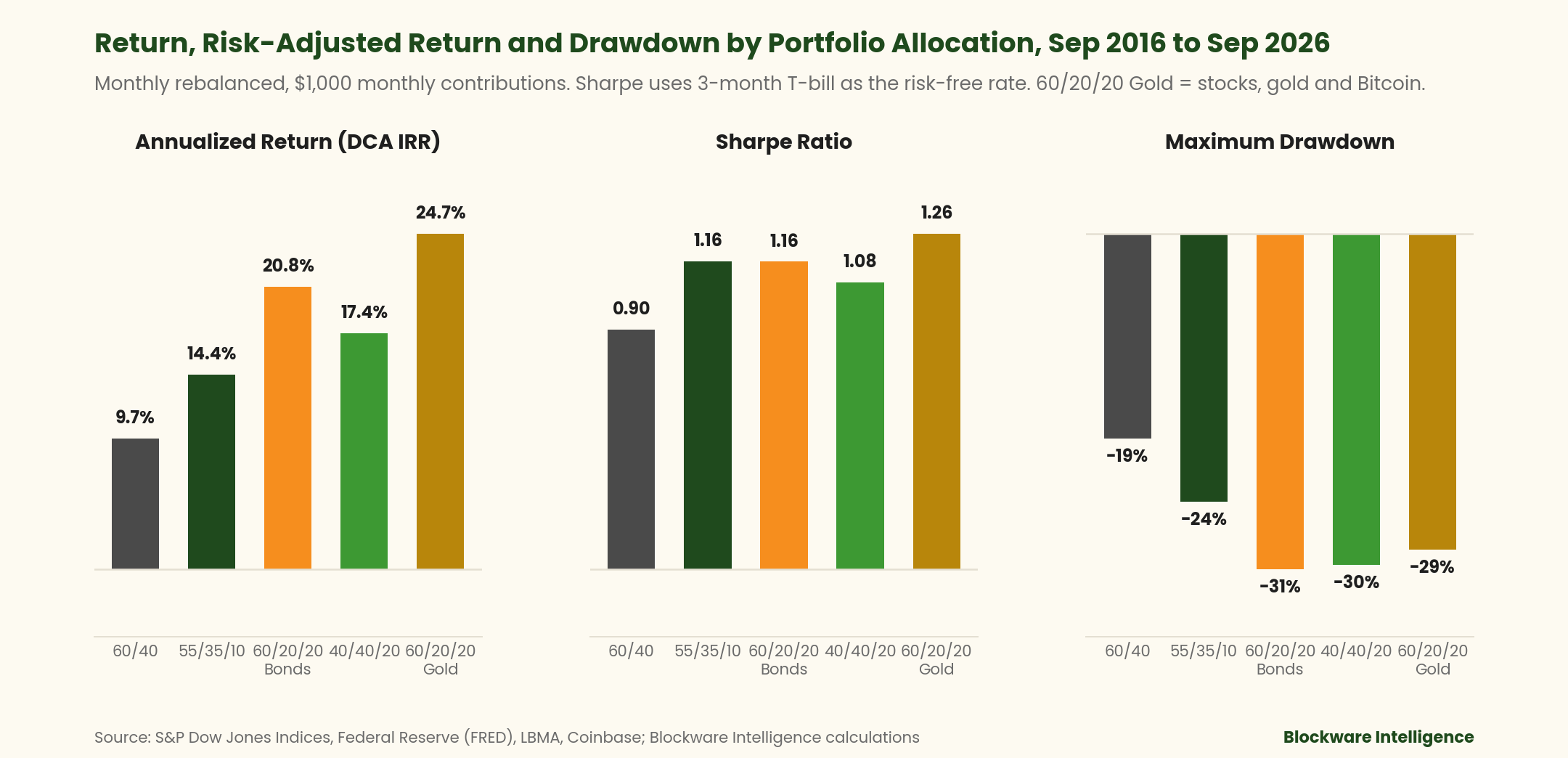
The table below shows the Sharpe Ratio / Risk-Adjusted Returns for each of these portfolios as well as the % maximum drawdown.
The usual objection is that Bitcoin adds risk, so the extra return isn’t free. Sharpe measures return per unit of volatility above the risk-free rate, and it’s the standard measure of whether you’re getting paid for the risk you take.
The traditional 60/40 posted a Sharpe of 0.90. Every portfolio with a Bitcoin position beat that.
The 55/35/10 came in at 1.16, the 60/20/20 at 1.16, and the 40/40/20 at 1.08. The 10% allocation may be the sweet spot for most investors. It raised the annualized return from 9.7% to 14.4%, raised the Sharpe ratio by almost 30%, and pushed the max drawdown from 19% to 24%, a cost of 5 points of drawdown for nearly 5 points of annual return.
The 20% allocations produced more absolute return but with drawdowns near 30%, and their Sharpe ratios didn’t improve on the 10% version. Past 10%, you’re adding volatility faster than you’re adding risk-adjusted return. But if you’re comfortable with Bitcoin’s volatility, then this is no problem.
The 60/20/20 stocks, gold and Bitcoin portfolio posted a Sharpe ratio of 1.26, the highest of any allocation we tested. Over the past decade the best risk-adjusted portfolio wasn't the one with the safe asset in it. It was the one that replaced the safe asset with a hard assets
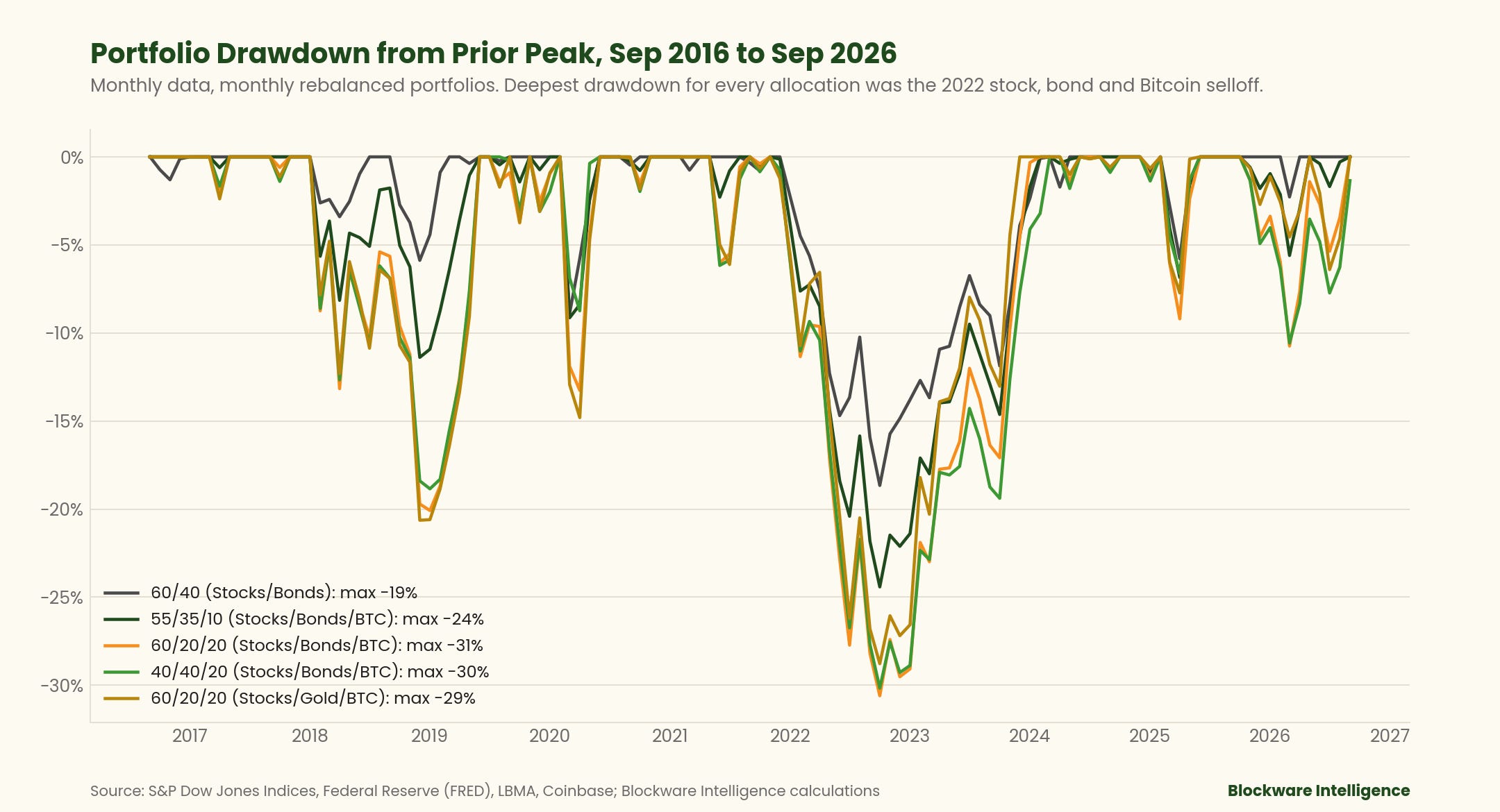
Every allocation hit its worst drawdown in the same month, October 2022, and that’s the most important signal.
In 2022 stocks fell 15%, the 10-year Treasury fell 15%, and Bitcoin fell 70%. The bond portion failed at the most important moment. The entire premise of the diversified portfolio is to have assets with inverse correlations; where bonds rise when stocks fall.
For investors with meaningful taxable income, there’s a way to build that Bitcoin position that the 60/40 can’t match.
Mining hardware qualifies for 100% first-year bonus depreciation under Section 168(k), so the purchase is deducted against income in year one while the machines produce Bitcoin every month afterward.
Reach out to sales@blockwaresolutions.com or download our free mining guide at https://blockwaresolutions.com/info/ for more information.

I'm buying 100 Years Government Bonds FYI
https://alejandroscorpio.substack.com/p/100-years-government-bonds?utm_source=share&utm_medium=android&r=8mzfdf
18-year ceiling broken is a level, not a story. Monthly close above it or it’s a wick.