


“Working harder” only gets you so far in an economy with a perpetually debasing currency. Unless you can increase your income faster than the rate of M2 growth (~7% per year), you’re going to fall behind.
The wealthiest people in the world work hard. But that’s not the difference maker. Plenty of people in the lower & middle class work hard. The difference between the wealthy and everyone else comes down to financial engineering.
They use assets to acquire more assets. They use the tax code the way it was written to be used. And they build systems where each dollar they deploy does more than one job at a time.
What we are about to walk through is exactly that kind of system. Mark Moss call is The Perpetual Bitcoin Machine. And it is one of the most compelling wealth strategies available to Bitcoin holders today.
Here is the core idea in one sentence: Borrow against the Bitcoin you already own, use those funds to purchase hosted Bitcoin miners, write off the full cost against your tax bill, and collect newly minted Bitcoin every single month — while your collateral keeps appreciating.
It’s a proven blueprint just with a new asset.
Let’s break down every step.
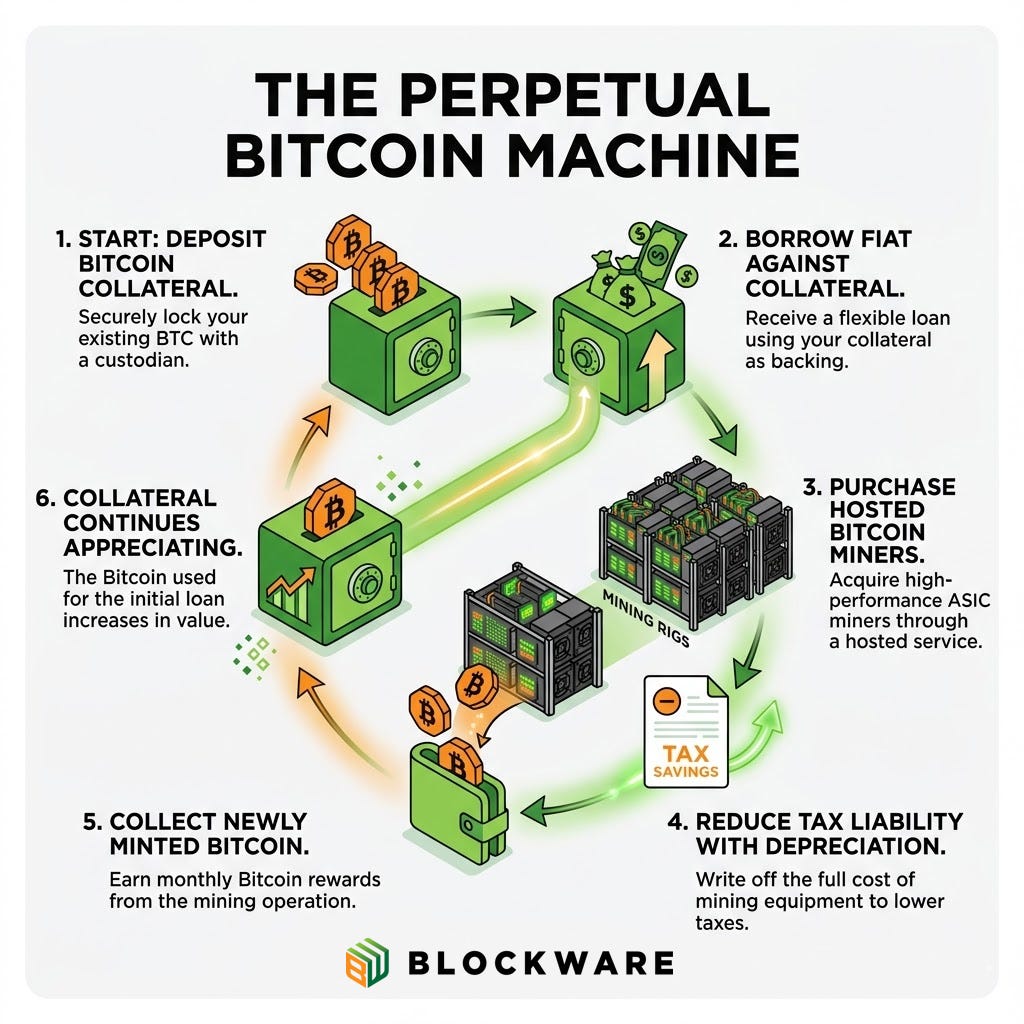
Before we get into the mechanics, let’s establish the starting point. This strategy is built for someone who:
Already holds a meaningful amount of Bitcoin (or another asset that can be leveraged: Real Estate, Equities, Whole Life Insurance, etc.)
Has a tax liability (W-2 income, business income, capital gains, or some combination)
Wants to acquire more Bitcoin without selling what they have
If that describes you, keep reading.
Step 1: Borrow Against Your Bitcoin
The first move is capital deployment — without triggering a taxable event.
Selling Bitcoin to fund an investment creates a capital gains tax event. Borrowing against it does not. A Bitcoin-backed loan allows you to access liquidity while your BTC continues to appreciate.
Here is how the loan structure works in this model:
Loan-to-Value (LTV): 33% — For every $3 of Bitcoin you hold, you can borrow $1. This conservative LTV gives significant cushion against price volatility and keeps margin call risk low.
Interest Rate: 9% annually, accruing monthly and rolling into the loan balance, no monthly cash payments required.
Term: 1 year, refinanced annually. The loan rolls forward each year, with accrued interest folded into the new principal.

Using the Tier 2 package as our model:
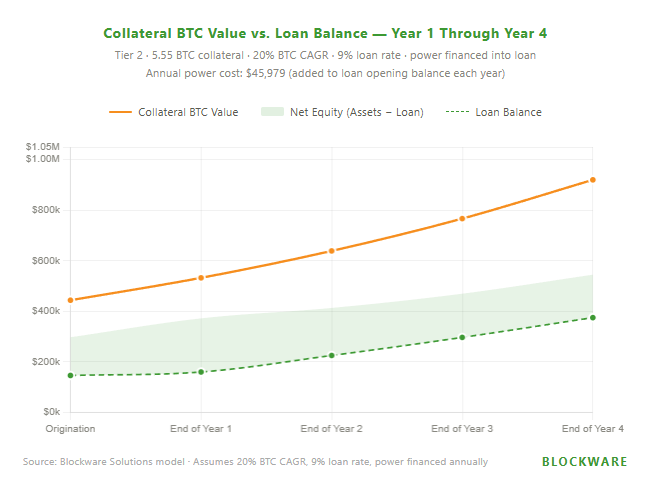
Loan amount: $150,000
Collateral BTC required: ~5.55 BTC
Collateral value at origination: ~$444,000
Starting LTV: 33%
Annual interest rate: 9%
Annual power cost of ~$46,000 added to loan balance each year
The $150,000 in loan proceeds funds the entire mining operation: 20 Bitcoin Miners (Antminer S21 XP, 270T), setup, and the first full year of power costs.
Step 2: Buy the Miners — and Reclaim Your Taxes
Under current IRS code, Bitcoin mining equipment qualifies as 5-year MACRS property — and it is eligible for 100% bonus depreciation in Year 1. This means you can deduct the full purchase price of the hardware from your taxable income in the year you buy it.
But the deduction does not stop at the hardware.
Electricity costs for Bitcoin mining are a deductible business expense. And there is a powerful timing strategy built into the Blockware bundle: because the first full year of power is prepaid upfront as part of the package, that entire power cost can be deducted in the same tax year as the hardware purchase — even though the electricity will be consumed over the following 12 months. This strategy, sometimes called a “prepaid expense deduction,” is well-established in tax law and allows you to pull forward a full year of operating deductions into Year 1.
The result: the entire $150,000 Tier 2 bundle is deductible in Year 1.
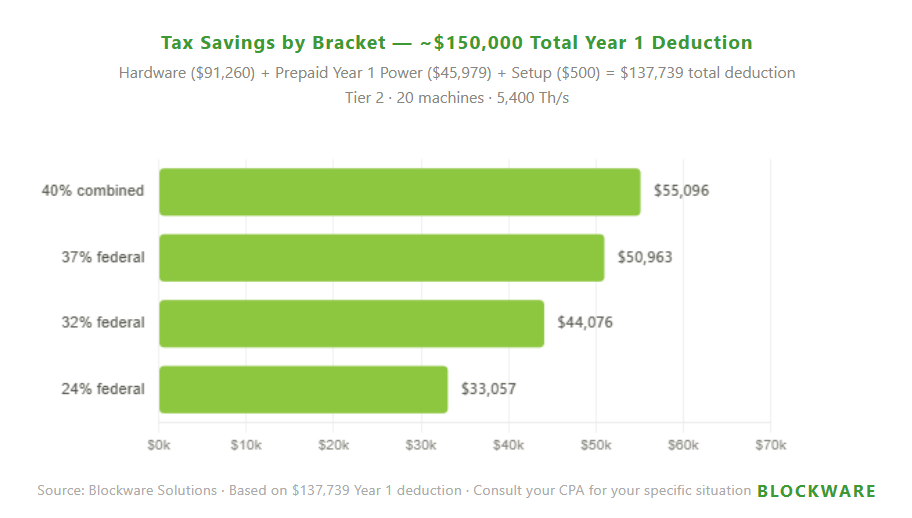
Here is what that looks like across different tax brackets:
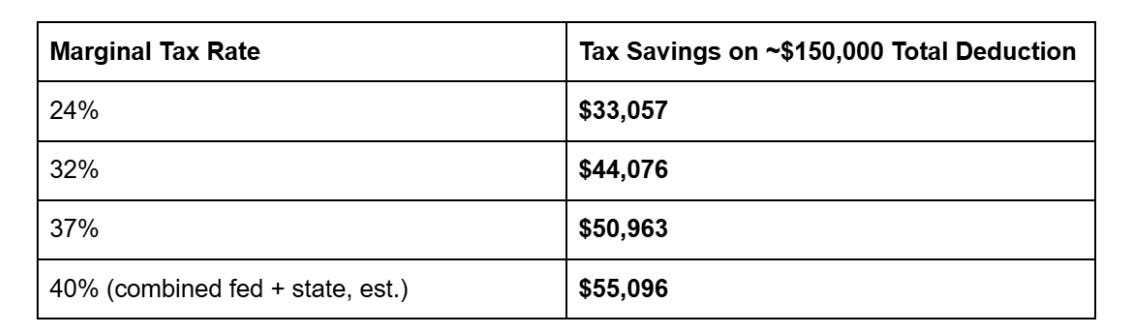
At a 37% marginal rate, the government effectively hands you back $50,963 of your $150,000 investment in Year 1 alone — before a single Bitcoin has been mined. Your effective out-of-pocket cost on the bundle drops to just under $99,000.
That is not a loophole. That is the tax code working exactly as Congress designed it — to incentivize capital investment in productive assets.
Consult your CPA or tax advisor to confirm eligibility and timing of deductions in your specific situation.
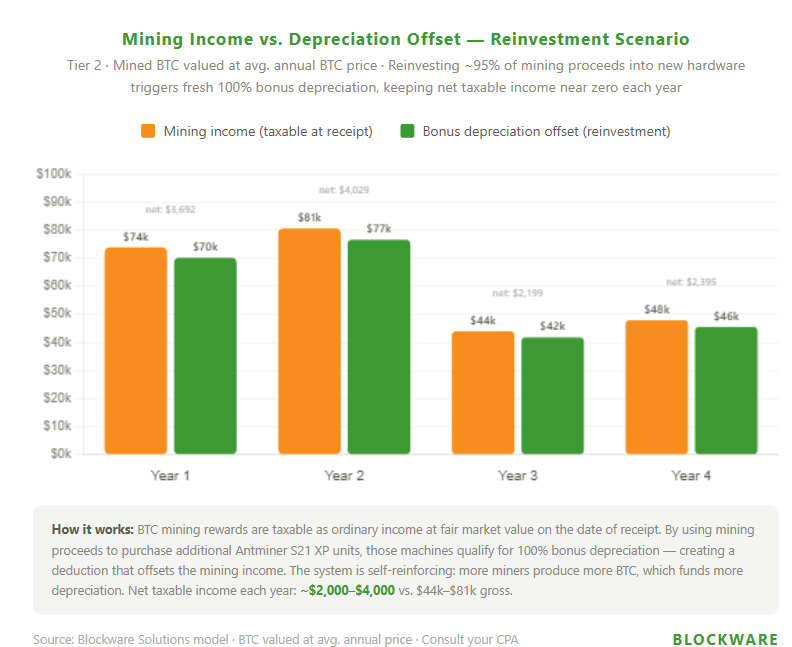
There is one more piece of the tax picture to understand before moving on: the Bitcoin your miners produce is taxable as ordinary income at the time it is received, based on the fair market value of BTC on the day of receipt.
This is a real consideration. For someone in the 37% bracket receiving 0.0736 BTC per month at today’s prices, the monthly tax liability is meaningful.
However, there is a natural and entirely legal solution built right into this strategy: use a portion of your mining proceeds to purchase additional miners. Those new miners generate a new round of bonus depreciation, which offsets the ordinary income from your current mining operation. The system feeds itself.
Step 3: Produce Bitcoin Around the Clock
Once the loan funds are deployed and the paperwork is signed, Blockware takes over completely. The miners are procured, deployed to institutional-grade facilities, and brought online, typically within 2 to 3 weeks of funding.
From that point forward, Bitcoin flows to your wallet automatically, every month, with no action required on your part.
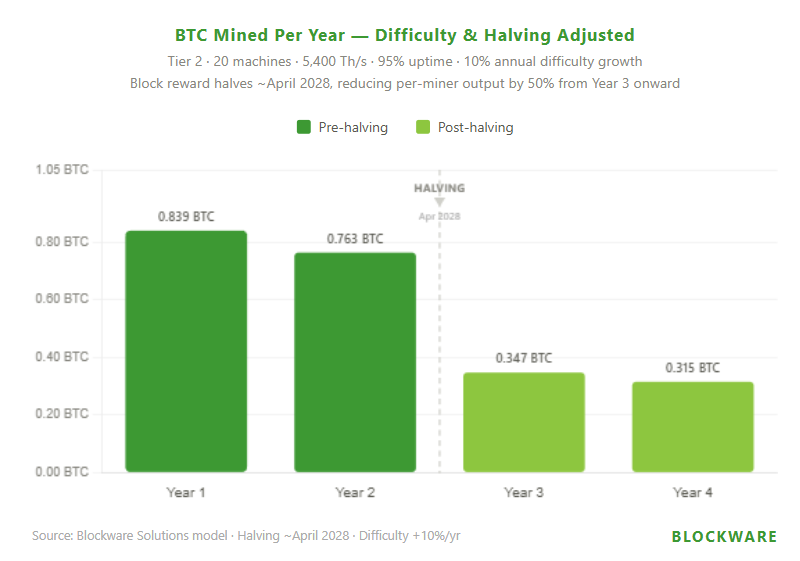
Here is what the Tier 2 production profile looks like over 4 years, incorporating two key real-world factors: annual difficulty growth of 10% (as more hashrate joins the network, each miner’s share of rewards shrinks) and the April 2028 halving, which cuts block rewards in half beginning in Year 3.
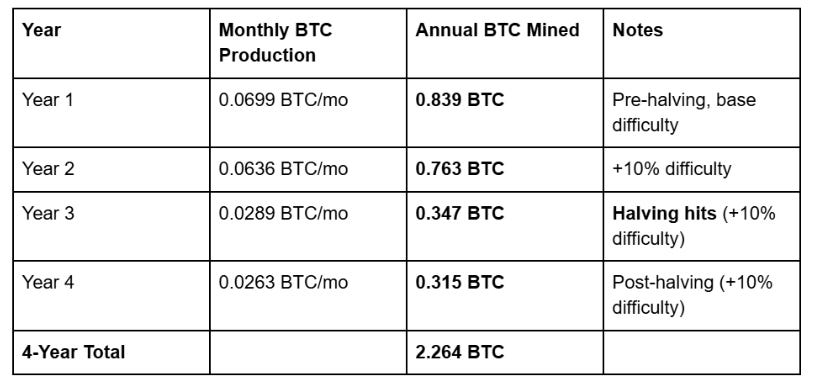
A natural question: if the halving cuts production in half, doesn’t that hurt the strategy?
It does reduce the amount of Bitcoin mined. But historically, every halving has been followed by a significant appreciation in Bitcoin’s price — because the same demand now faces half the new supply. The miners you own continue operating. The Bitcoin you have accumulated is worth more. And critically, your collateral is worth more too, which improves your LTV and borrowing capacity going forward.
The Full Picture: 4-Year Portfolio Snapshot
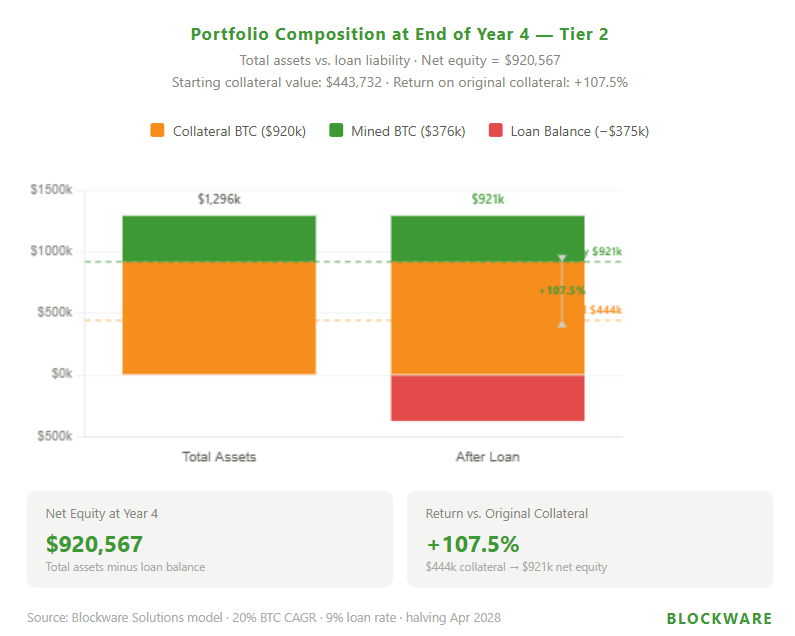
Now let’s put the whole machine together. This is what the Tier 2 strategy looks like as a complete portfolio at the end of Year 4, under the model’s base assumptions (20% annual BTC price growth, 10% annual difficulty increase, 9% loan rate, April 2028 halving).
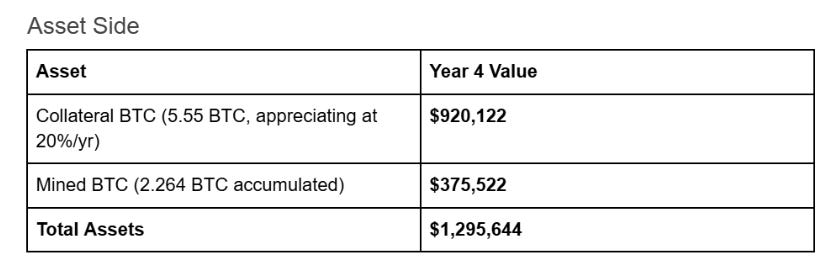
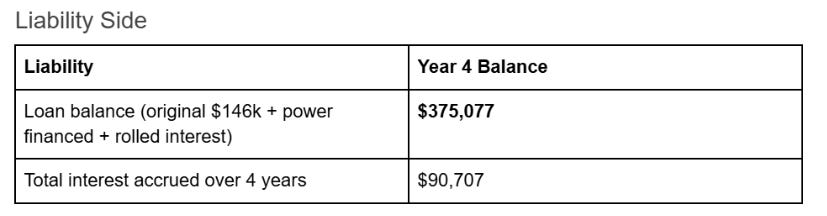
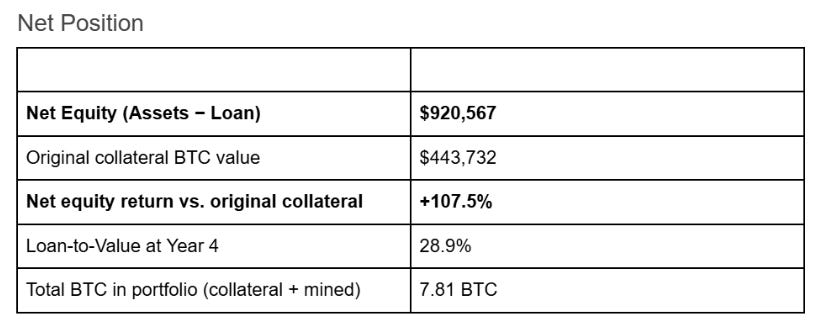
Your collateral appreciated by $476,000. Your miners produced 2.264 BTC worth $375,000 at Year 4 prices. You recovered over $50,000 in taxes in Year 1 alone. And you did all of it without selling a single bitcoin.
Why This Works: The Three Engines Running Simultaneously
Most investments have one engine. This strategy has three, running in parallel:
Engine 1: Bitcoin price appreciation. Your collateral BTC grows in value over time. At 20% CAGR, 5.55 BTC grows from a $444,000 pledged value to $920,000 in four years — an increase of $476,000 on an asset you never sold.
Engine 2: Tax recapture. In Year 1, the government effectively subsidizes your investment through bonus depreciation and the power prepayment deduction. At a 37% marginal rate, you recover more than $50,000 of a $150,000 investment before the miners even turn on. That subsidy is permanent — it does not have to be repaid.
Engine 3: Continuous BTC production. Your miners run 24 hours a day, 7 days a week, 365 days a year — producing Bitcoin that flows directly to your wallet, regardless of what price does in the short term. Over 4 years, you accumulate ~2.264 BTC from mining alone.
None of these engines cannibalizes the others. They compound together.
The Tradeoffs
No strategy worth understanding is without risk. Here are the ones you should know:
Loan risk. If BTC price falls significantly, your LTV rises. A sustained price decline could trigger a margin call, requiring you to post additional collateral or repay part of the loan. The 33% starting LTV provides substantial cushion — BTC would need to fall roughly 60%+ from origination to approach a typical margin call threshold — but it is not zero risk.
Difficulty growth. If more hashrate comes online faster than modeled, BTC production per miner falls faster than projected. We model 10% annual difficulty growth, which is conservative relative to historical norms but may understate growth in a strong bull market. That being said, the widespread pivot of large, public Bitcoin miners to Ai / HPC has triggered the first ever bear market in mining difficulty (down ~15% over the past six months).
Halving impact. The April 2028 halving is baked into these projections. Production drops roughly 50% beginning in Year 3. Historically, price appreciation has compensated — but there is no guarantee that pattern repeats on the same timeline.
BTC price assumption. The 20% CAGR assumption is adjustable in the model and is not a guarantee. All projected dollar values are a function of this assumption. Lower BTC appreciation reduces returns; higher appreciation amplifies them. 20% per year over the next 4 years would yield a BTC Price of ~$165,000; that seems reasonable to us.
All that being said, the biggest risk is inaction. You must have have a plan to beat inflation, minimize taxes, and build a wealth-compounding system.
This is it.
Who This Is Built For
The Perpetual Bitcoin Machine is most powerful for someone who:
Holds BTC already and wants to put it to work without selling
Has $100,000 – $500,000 in annual tax liability — business income, W-2 compensation, capital gains, or some combination
Has a 3–4 year time horizon and is not looking for a short-term trade
How to Get Started
The best way to get started is to schedule a consultation with a member of the Blockware team. It’s free. It takes 30 minutes. And it could potentially save you tens or hundreds of thousands in taxes.
Fill out the form here and a member of our team will contact you in less than 24 hours to schedule a meeting: https://www.blockwaresolutions.com/info